In July 2026, Jean Paul Gaultier presented its Fall/Winter 2026/27 collection. This happened during Paris Haute Couture Week. It was the first couture presentation under Duran Lantink. He is the designer tasked with steering the house into a new era.
Duran Lantink is not just another creative director. After all, he followed a three-year run of guest designers. These included Chitose Abe, Glenn Martens, and Haider Ackermann. This Dutch designer from Amsterdam became the first permanent successor to Gaultier himself.
His couture debut was titled “Tech Couture.” It was already his fourth collection for the house. Before it came two ready-to-wear shows. The show took place in a ballroom on rue Saint-Martin. The space was wrapped entirely in white padded fabric. It felt as if the house were resetting itself. Meanwhile, Gaultier watched the entire show from the front row.
Marie Antoinette as Provocation, Not Costume
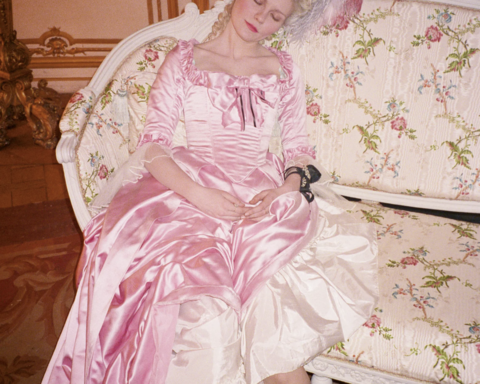
Lantink deliberately avoided the house’s most obvious signatures. He skipped the marinière stripes and the cone bras. Instead, he reached for a quieter layer of Gaultier’s legacy. This included body-hugging jumpsuits and chunky Aran-style knits. It also included men in couture and sculptural tailoring. For inspiration, he chose Marie Antoinette.
She is one of the most overused references in haute couture history. However, the court dresses become an exercise in glorified impracticality. After all, couture was never about practicality. It was always about fantasy pushed to its limit.
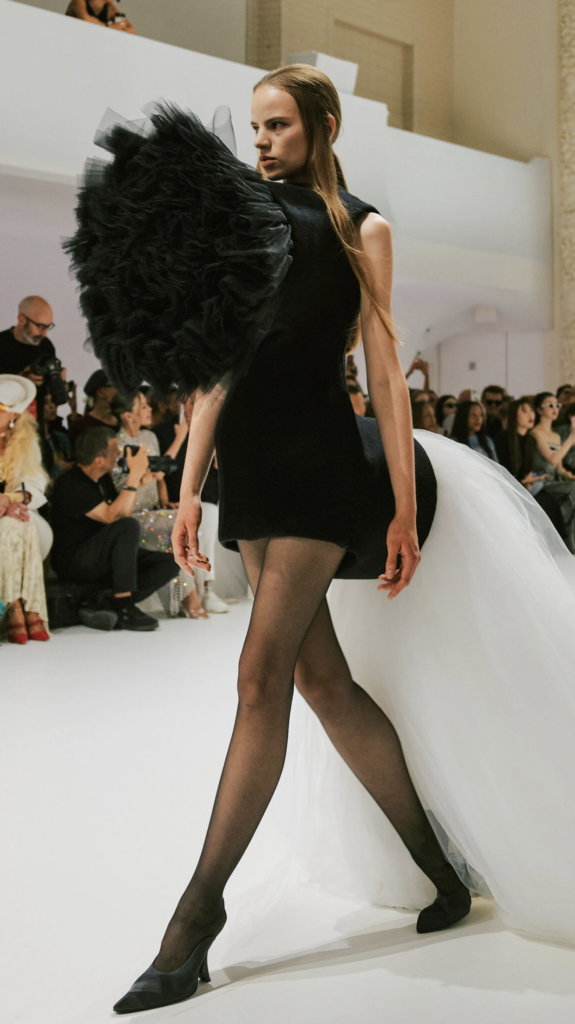
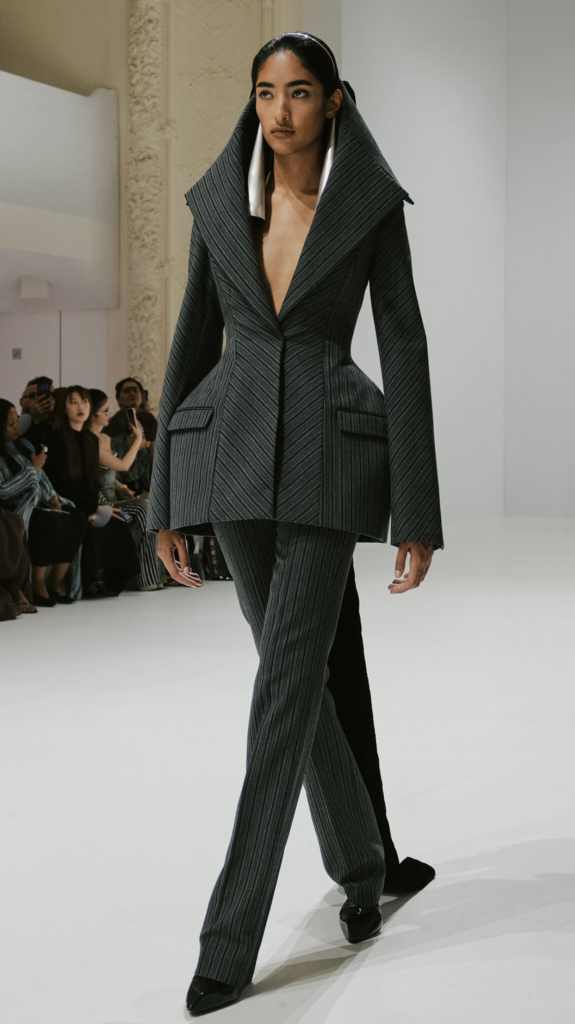
Therefore, the choice of theme is neither random nor one-sided. In fact, Gaultier himself sent a similar look down the runway in 1998. That look featured a ship on the model’s head. It drew from the same eighteenth-century court era. So Lantink’s debut also functions as a quiet dialogue with Gaultier’s archive.
Recycling and Reworking Old Materials
First, recycling became key to understanding this collection. A jacket made of recycled denim references Gaultier’s own 1997 couture debut. Back then, hand-embroidered denim came from the famed atelier Lesage. It was made directly from his own old trousers.
A more striking reference is guipure. This is a lace with a thick, raised pattern and no ground net. Gaultier used it in his “Cages” collection from fall 2008. Now, Lantink translated it into cape dresses resembling armor. Overall, the archive is not repeated verbatim. Instead, it gets taken apart and reassembled.
The Body as Data
The most radical piece was created for model Leon Dame. Lantink used 3D scanning of his torso for this. The result is a leather, corset-like cast. It precisely mirrors the model’s anatomy, moles included. As a result, the piece sits between armor and sculpture. It is a body translated into data and back into fabric.
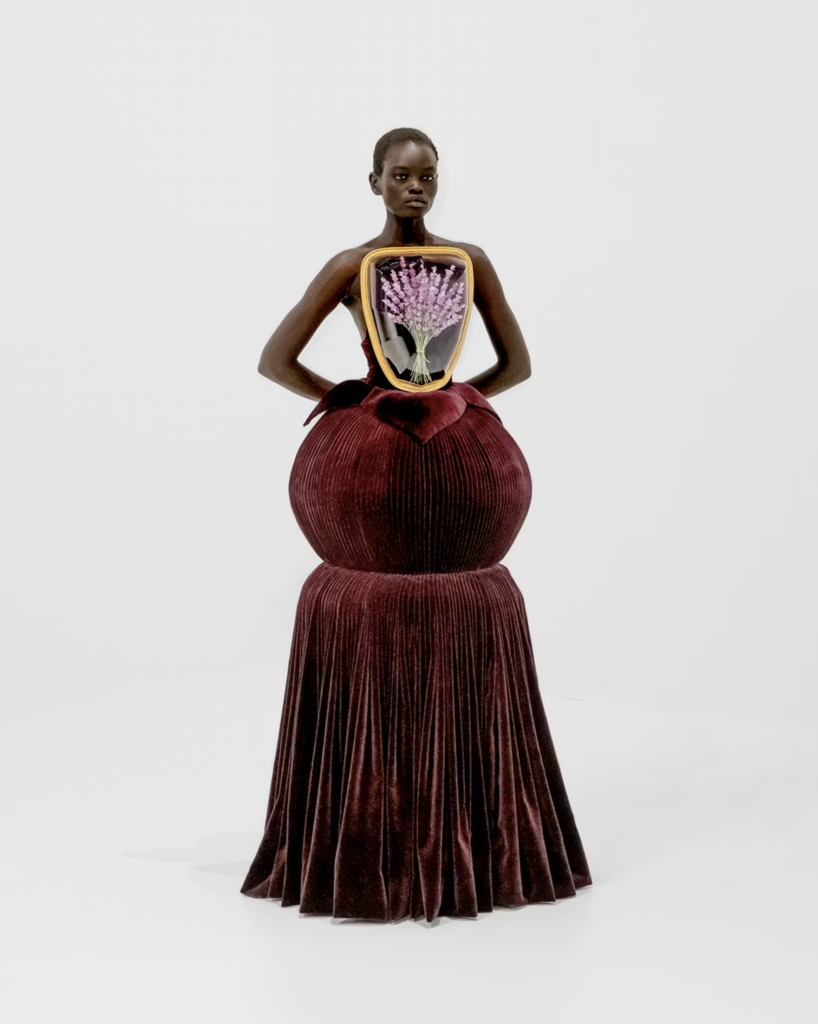

A similar principle runs through the whole collection. Classic techniques meet 3D-printed flexible TPU and PA12. These techniques include corsets, cage crinolines, and padded panniers. One black mini-crinoline shows this best. It is studded with glass tube beads. At the same time, it uses industrial honeycomb padding.
“I prefer to interrogate the silhouette rather than the body,” Lantink wrote in the show notes. “I want to challenge the garment itself, to push it to the very limits of its sculptural potential.”
A Laboratory, Not Nostalgia
The collection’s inspiration reaches far beyond Versailles. Marie Antoinette is joined by other figures. Like Gaultier, they also played with the boundaries of body and form. One is American designer Charles James. His legendary “petal” evening gowns date from the 1940s. Another is German painter Richard Lindner.
His theatrical canvases merge human figures with mechanical elements. Consequently, collars rose forward like a ship’s prow. Some curled into biomorphic shapes around the torso. Meanwhile, shoulder lines exceeded even extreme bodybuilder proportions.


Overall, the result doesn’t read as nostalgic repetition. Instead, it takes Gaultier’s mythology apart and reassembles it. It still feels unmistakably like the house. Humor and theatricality remain intact. So does the obsession with reshaping identity through clothing. Only the language speaking it now belongs to Lantink.