At the Embassy of Italy in Berlin, visitors will find an unusual encounter until 25 September, Caravaggio’s Mary Magdalene in Ecstasy (c. 1606) hangs alongside a new sculpture by Belgian artist Berlinde De Bruyckere. It’s the first public showing of this Caravaggio in Germany. Offsite Arts organised the exhibition in partnership with the Embassy of Italy, curated by Tjioe Meyer-Hecken and Felipe Schwager. Admission is free, by appointment.

Two artists, four centuries, one body
Caravaggio painted Mary Magdalene the year he fled Rome. The work belongs to his late, stripped-back period. He removed almost everything staged from it, no elaborate setting, no symbolic attributes, just a figure emerging from darkness. Her head falls back, her hands loosely clasped, her body suspended between surrender and consciousness. Rather than a biblical scene, Caravaggio thus captures a state in which spiritual rapture and human vulnerability become inseparable. He worked from a model with strong directional light, so sacred subjects took on the bodies and faces of ordinary people.
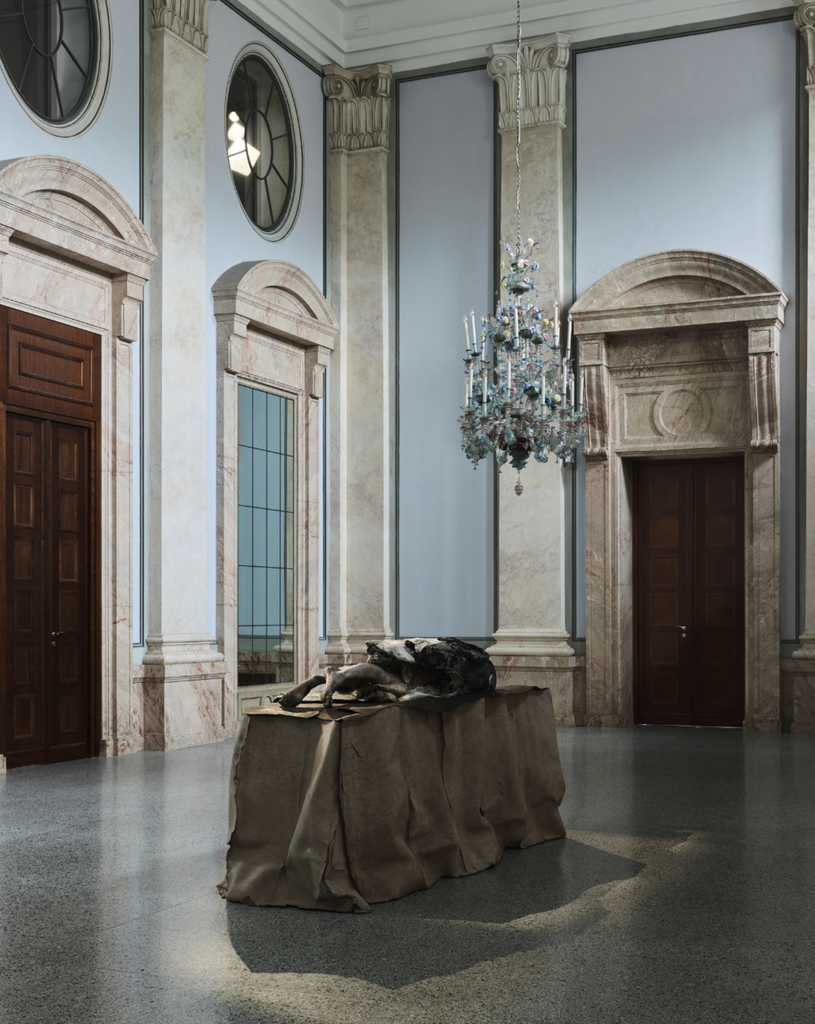
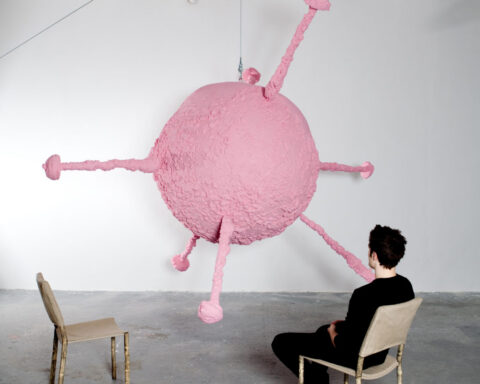
Four centuries later, De Bruyckere approaches the same figure through the physical language of matter. Her work M.M. MMXXVI, or Maria Magdalena 2026, was made specifically for this Berlin presentation, continuing her longer series Liggende Arcangelo. She made it from wax, linoleum, hair and wood, so the material carries traces of touch, weight and time. Body and support merge into one, the pedestal is torn, darkened and folded into pleats, evoking draped cloth and wounded skin at once. Dark marks on the heels suggest a long journey and a body pushed to the limit of endurance.
Crossover: a sculptor who keeps returning to the vulnerable body
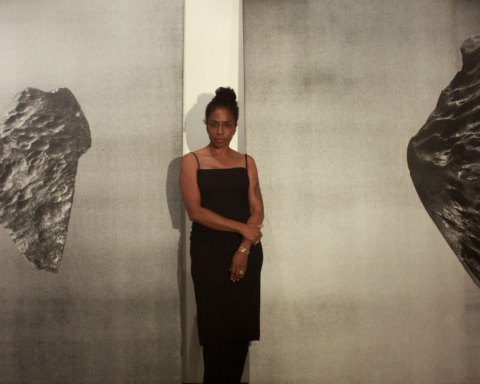
Berlinde De Bruyckere was born in 1964 in Ghent, Belgium, where she still lives and works. She’s represented by Hauser & Wirth and Galleria Continua. She’s a butcher’s daughter, and that experience feeds directly into her lifelong focus on physical suffering and wounded flesh. She represented Belgium at the Venice Biennale in 2013, and has also exhibited at the Istanbul Biennial. In her work she uses wool, animal hide, wood and wax, materials capable of carrying both weight and fragility at once. She has said herself that she wants to show how helpless a body can be, and that this isn’t something to fear, it can be something beautiful.

A meeting on diplomatic ground
The curators placed the presentation directly inside the embassy rather than a museum, giving it an intimate, deliberately unexpected character. Italian Ambassador Fabrizio Bucci, at the opening, highlighted the embassy’s transformation into an open cultural space capable of fostering new forms of expression.
Where and when
Embassy of Italy, Berlin, Hiroshimastraße 1. The exhibition runs until 25 September 2026, admission free, by appointment.