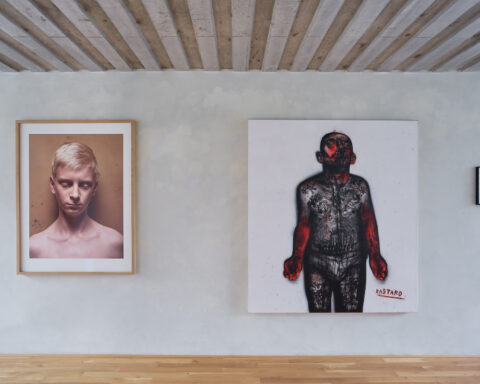
Art should no longer be something to be viewed, but something to be handled, Franz West said. His sculptures can be worn, held or sat on. For what would have been his 80th birthday, Albertina Modern is dedicating to him the largest retrospective to date.
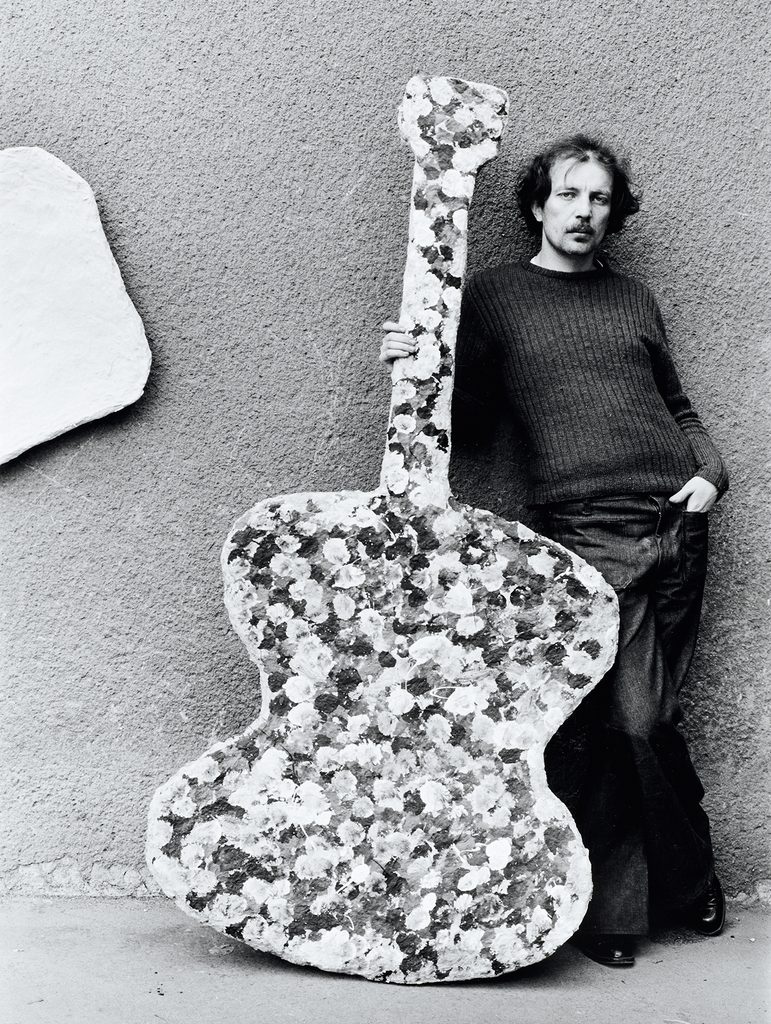
Who was Franz West
Franz West (1947–2012) was a Viennese artist who came to art late and took it with humour. He worked with what others overlooked or threw away: papier-mâché, gauze, advertising flyers, leftover paint, newspaper clippings and scrap metal. In doing so, he broke down hierarchies and created a more democratic aesthetic.
He was also drawn to the margins of society and to subjects people don’t talk about: neuroses, sexual innuendo, insecurity about one’s own body. He exhibited repeatedly at documenta and the Venice Biennale, where in 2011, a year before his death, he received the Golden Lion for Lifetime Achievement.
His works are in the collections of the Centre Pompidou, Tate, MoMA and the Albertina itself. Today his foundation is represented by Gagosian, while David Zwirner, who discovered him first, works with his archive and estate.

Adaptives: sculptures to wear
In the 1970s West began making his Passstücke. The name came from his friend, the poet Reinhard Priessnitz; West himself later preferred the English Adaptives. Viennese Actionism was an important starting point, but unlike the Actionists, West never abandoned the tangible object.
The Adaptives are prosthesis-like forms that only make sense when used. Viewers wear them, hold them, turn them or pose with them, and the sculpture becomes a situation.
Referring to Freud, West called them “neuroses made visible”. They were meant to be surfaces onto which people project their inner conflicts and social norms. Art thus becomes a way of observing oneself.

Sitting on art
West later carried the ideas of the Adaptives into furniture made of steel and aluminium and into outdoor sculptures, most of them meant to be used. Sitting, lying down and resting become part of the artistic experience. West welded metal chairs and divans, some only lightly padded and upholstered in raw linen. His 2008 exhibition at the MAK in Vienna was fittingly titled Sit on My Chair, Lay on My Bed.
In the late 1990s he turned to large sculptures in lacquered aluminium. The first were inspired by the shape of Viennese sausages, later ones by the forms of the Adaptives. These too are meant for sitting or lying on.
He said the colours of his public sculptures, such as bubblegum pink and lemon yellow, came from children’s pyjamas and public toilets. The pink and multicoloured loops of The Ego and the Id (2007) rise more than six metres high, with stools at their base.
Art Basel showed what this looks like on a large scale. In the 2019 Unlimited sector, David Zwirner and Hauser & Wirth presented his installation Test (1994): 28 sofas made of steel and foam rubber, with colourful covers by the artist Gilbert Bretterbauer.
Test was first installed in 1994 outside the Museum of Contemporary Art in Los Angeles, in four rows of seven sofas. After that, no one saw it for 25 years. It followed on from Auditorium (1992), a set of sofas West had shown earlier at documenta in Kassel.

West and fashion
In June 2023, Jonathan Anderson presented LOEWE’s spring/summer 2024 menswear collection with the short film I Dreamt of LOEWE. It was directed by Luca Guadagnino and shot at David Zwirner in New York, among West’s sculptures from the Echolalia series (2010).
Model Andrea Isidori falls asleep on West’s divan and, in his dream, finds himself among the artist’s colourful, larger-than-life sculptures. The two-minute film shows how naturally West fits into fashion: his sculptures have been about the body from the very beginning.

Franz West. The Revolution of Sculpture
West would have turned 80 on 16 February 2027. To mark the occasion, Albertina Modern is dedicating to him his largest retrospective to date, with works from the early 1970s up to 2012. The curators are Angela Stief and Constanze Malissa.
The exhibition starts from the Adaptives and traces how the furniture, the lemurs and the aluminium sculptures grew out of them. It is complemented by walls full of drawings and collages, which West used just like his sculptures: as triggers of feeling.
The opening is on 5 November, and the exhibition runs from 6 November 2026 to 29 March 2027. Anyone who wants to see how Vienna itself shaped West will find the answer at the Wien Museum in the exhibition Franz West und Wien (until 2 May 2027).

Sources
- Albertina, press text for Franz West. The Revolution of Sculpture
- Albertina
- Wien Museum
- Gagosian, Franz West
- Wikipedia, Franz West
- The Art Newspaper, the dispute over Franz West’s estate
- LOEWE, I Dreamt of LOEWE
- Wallpaper*, Guadagnino and Anderson for LOEWE
- David Zwirner, Art Basel Unlimited 2019
- Art Basel, Franz West: Test
- Hauser & Wirth, Gianni Jetzer on Art Basel Unlimited 2019
- MOCA Los Angeles, Focus Series: Franz West (1994)