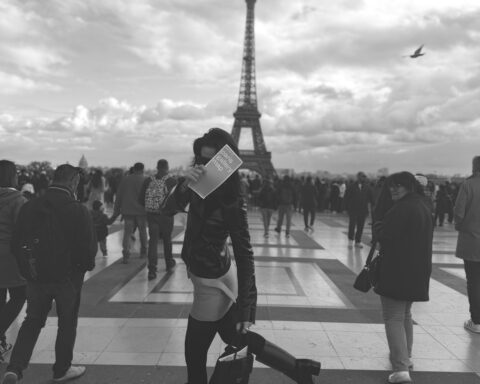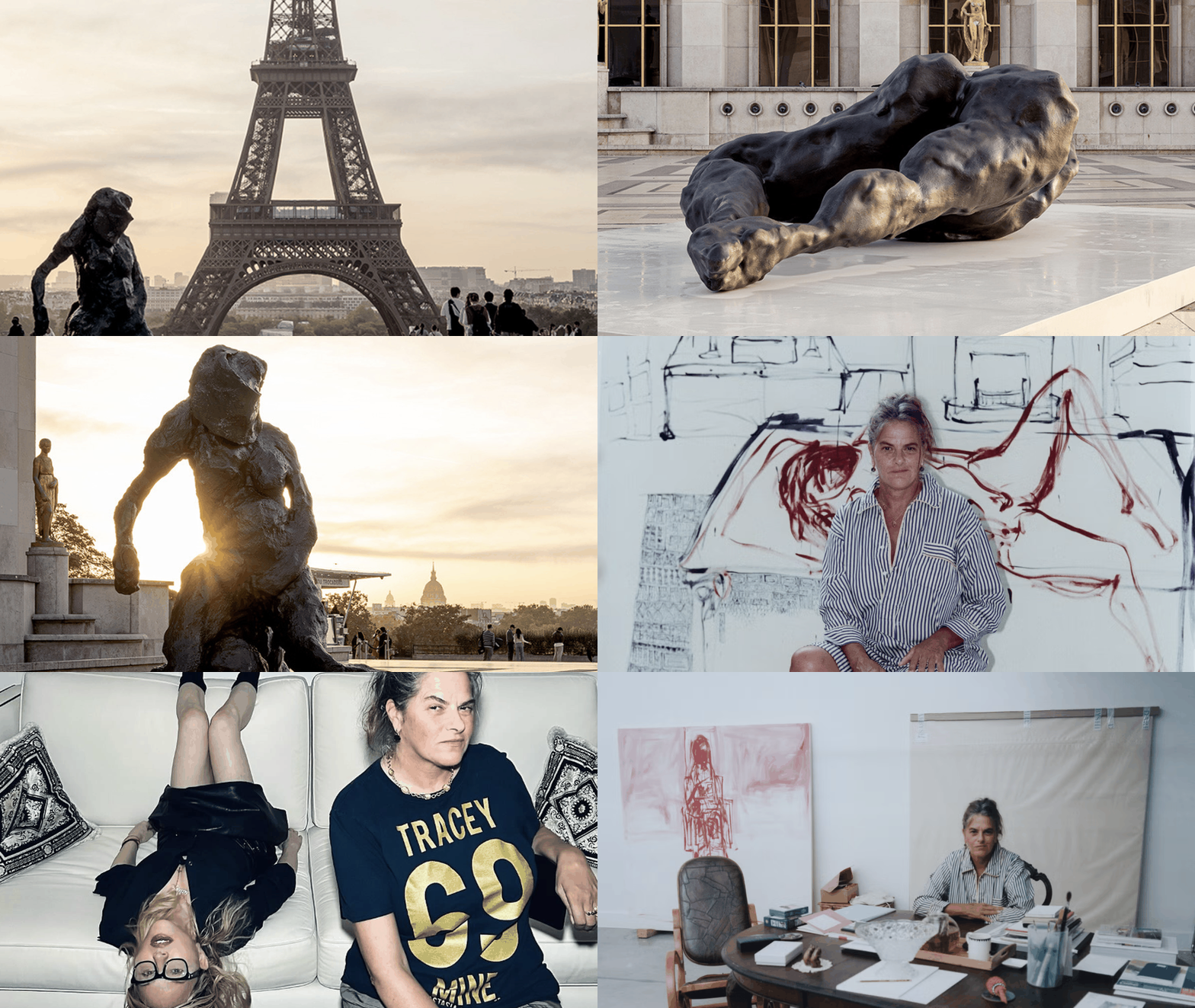
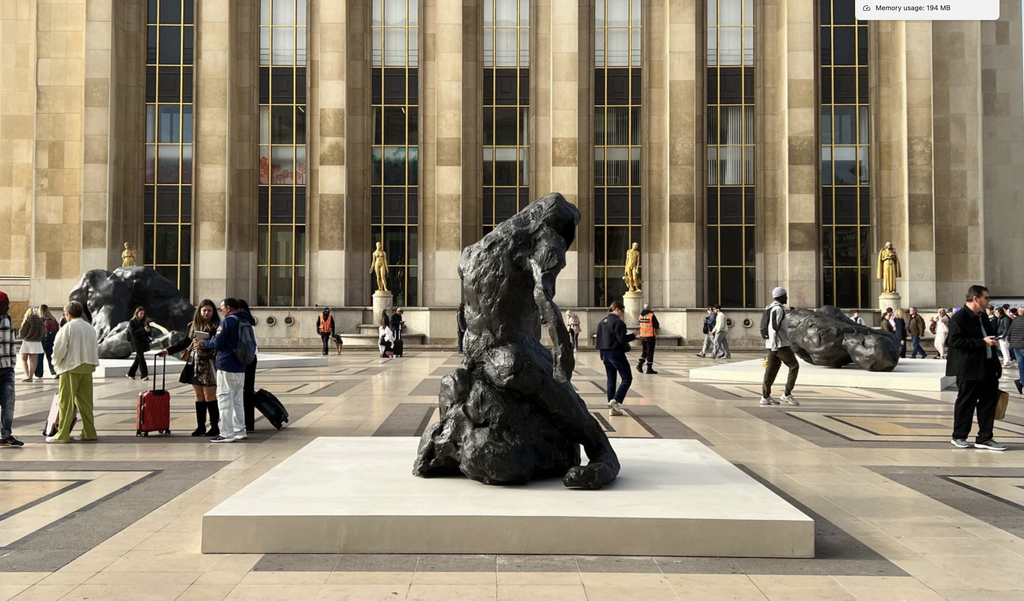
Three women of bronze now stand on the Trocadéro. One lies down, one kneels, one sits on a rock. Behind them rises the Palais de Chaillot, in front of them the Eiffel Tower. Tracey Emin in Paris does not bring a monument to a hero. She brings a monument to survival.
If you know the name only from headlines about an unmade bed, it is time to catch up. Emin is one of the most influential artists of her generation. And her story is the key to why these sculptures feel so powerful.
Who is Tracey Emin: long story short
She was born in 1963 in Croydon and grew up in seaside Margate. She studied printmaking in Maidstone and painting at the Royal College of Art in London. After graduating, she went through two traumatic abortions. She destroyed everything she had painted up to that point.
Then she made a radical decision. Her own life became her material. Rape at thirteen, abortions, alcohol, breakups, Margate. Everything other people hide, Emin put on show.
In 1993 she opened The Shop with Sarah Lucas in London’s Bethnal Green. That same year she had her first solo show at White Cube. At thirty, she ironically titled it My Major Retrospective. White Cube still represents her today.
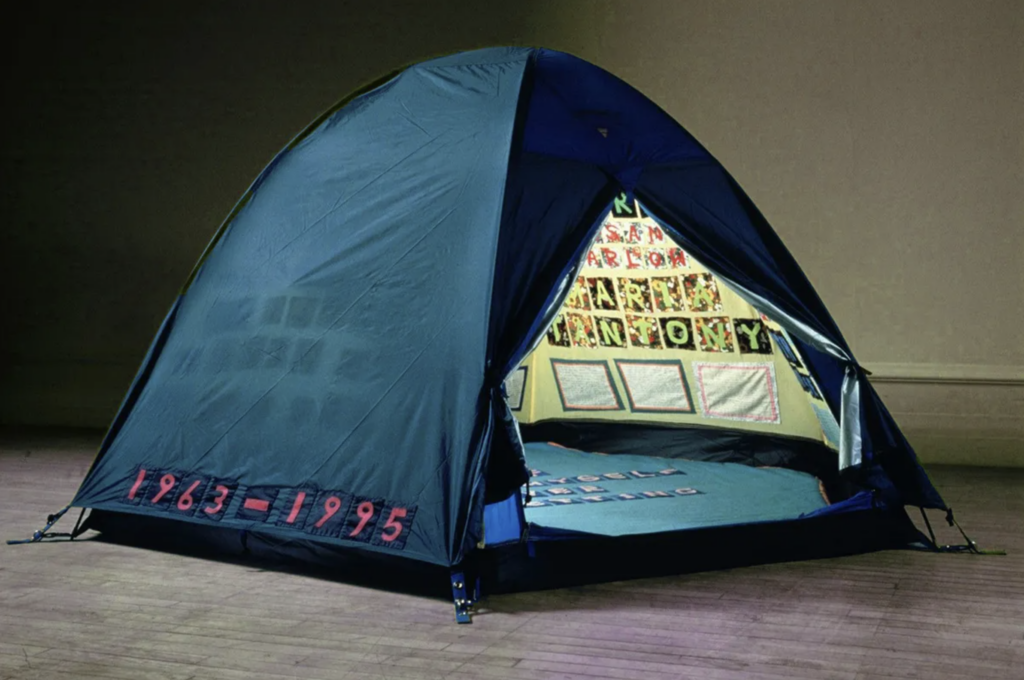
In 1995 she sewed a tent called Everyone I Have Ever Slept With 1963–1995. Inside, she stitched the names of everyone she had ever slept next to. Not just lovers. The list included childhood relatives, her twin brother and two unborn children. Charles Saatchi later bought the tent. In 2004 it was destroyed in the Momart warehouse fire.

The bed that changed British art
The wider public discovered her in 1997. She appeared drunk on a live Channel 4 debate about the Turner Prize, swore and walked out of the studio. Britain had a new enfant terrible.
Two years later she was nominated for the Turner Prize herself. At the Tate she showed My Bed: her unmade bed after days of depression, with stained sheets, condoms, cigarette butts and bottles. Two performers jumped on it and had a pillow fight for an hour and a quarter. The media went wild. Steve McQueen won the prize in the end, but the year belonged to Emin.
Saatchi bought the bed for £150,000. In 2014 it sold at Christie’s for £2.5 million. The buyer was Jay Jopling, founder of White Cube.
Today My Bed reads differently. Emin shared her most intimate moments in public long before Instagram and reality TV. Her confessional art was ahead of an era that made oversharing the norm.
From enfant terrible to Dame
Emin was part of the Young British Artists generation and the Cool Britannia era. Unlike many of them, she did not remain just a scandal.
In 2007 she represented Britain at the Venice Biennale. She was the second woman to have a solo show in the British Pavilion, after Rachel Whiteread. That same year she became a member of the Royal Academy. In 2011 she was appointed its Professor of Drawing. She and Fiona Rae became the Academy’s first female professors since its founding in 1768.
In 2024 the King made her a Dame. Margate named her an honorary freewoman. There she now funds TKE Studios, offering studios and residencies to young artists.
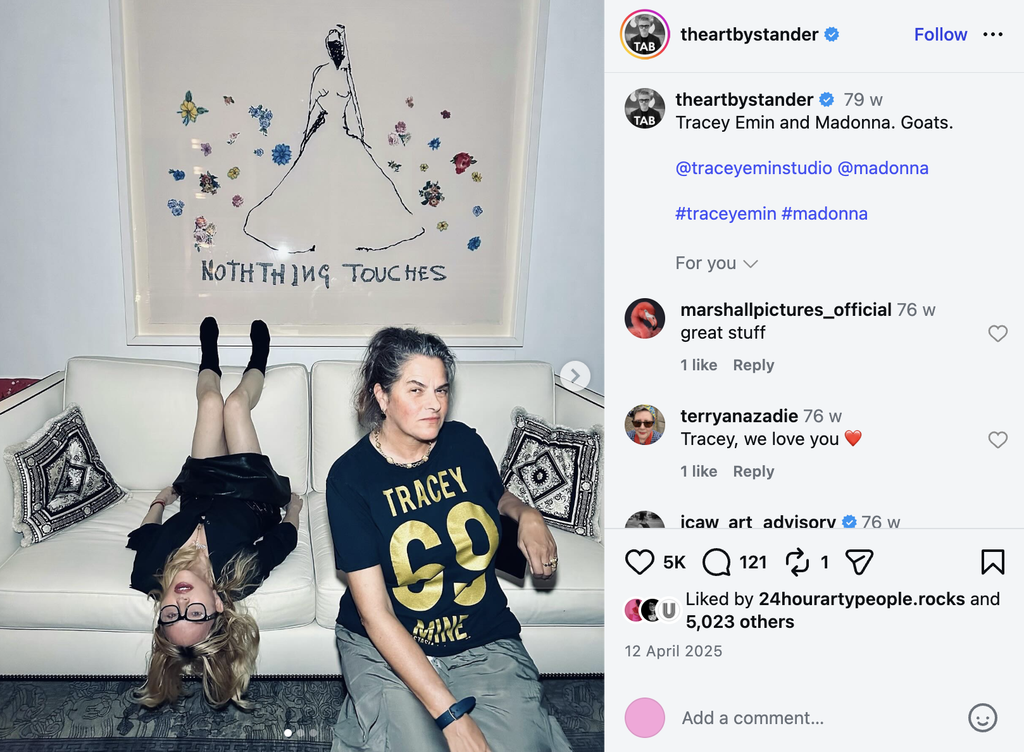
Pop culture has always orbited Emin. Madonna called her intelligent, wounded and unafraid to expose herself. David Bowie compared her to William Blake, had Blake been a woman. And her Tate Modern retrospective was presented in partnership with Gucci.
A second life
In 2020 Emin was diagnosed with bladder cancer. She underwent major surgery and is now in remission. Since then she has painted and made work with new intensity.
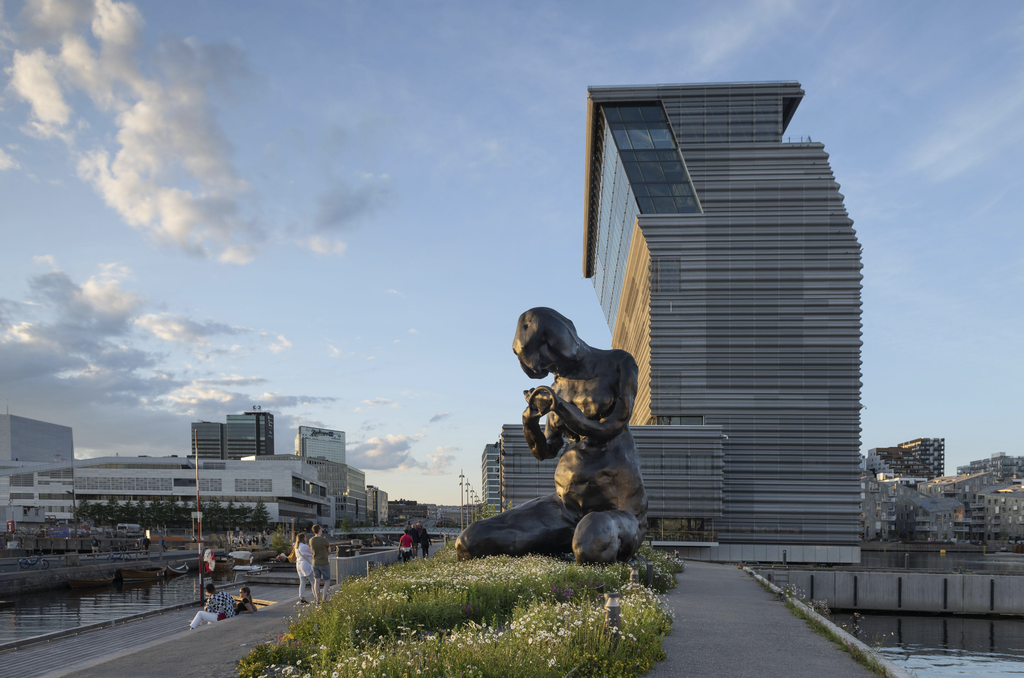
In June 2022, her nine-metre bronze sculpture The Mother was unveiled outside the Munch Museum in Oslo. Munch has been her lifelong hero. A monumental female bronze is nothing new in her work. Paris picks up where Oslo left off.
This year Tate Modern gave her the largest exhibition of her career to date. Tracey Emin: A Second Life ran from 27 February to 31 August 2026 and featured more than 90 works. The title refers to life after illness. The exhibition now travels to the Louisiana Museum of Modern Art in Denmark, where it runs until 18 April 2027.
Tracey Emin in Paris: three sculptures, three positions of the body
Art Basel Paris, White Cube and the Cité de l’architecture et du patrimoine now present three of her monumental bronzes. The installation runs from 14 October to 1 November 2026. Admission is free. It is the first Art Basel Paris Public Program project on the Parvis des Droits de l’Homme.
I lay here for you (2018) shows an elongated figure lying on the ground. The body hovers between exposure and withdrawal.
I Followed You to the End (2024) raises the body into a kneel. The parted legs are ambiguous: a tender invitation, or brutal submission? The same title was given to her White Cube Bermondsey exhibition in 2024.
I Will Not Be Alone (2025) presents a woman seated on a rock. Her face is veiled. This is not a portrait, but a collective body of strength and endurance.
Why this square
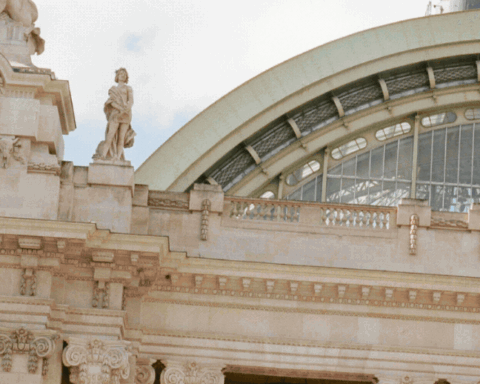
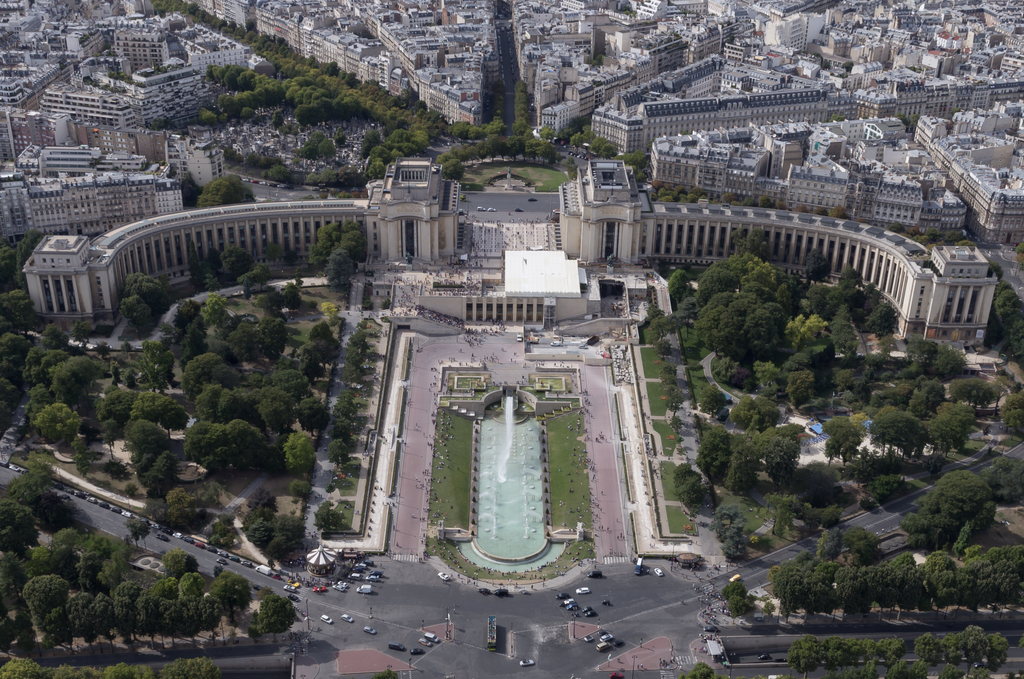
The Palais de Chaillot was built for the 1937 World’s Fair. It was designed by Léon Azéma, Jacques Carlu and Louis-Hippolyte Boileau. On 10 December 1948, the UN General Assembly adopted the Universal Declaration of Human Rights here. In 1985 President Mitterrand renamed the esplanade the Parvis des Droits de l’Homme.
So Emin places the vulnerable female body on a square named after human rights. Its Declaration speaks of equal dignity. Emin’s sculptures ask what dignity looks like in a body that has survived pain.
Eight gilded bronze statues from 1937 also line the esplanade, such as Flore by Marcel Gimond. They are smooth, gleaming and ideal. Emin’s women have rough surfaces full of handprints. Here, the ideal stands next to the real.
Bronze, Bourgeois and a train station
As late as 2002, Emin claimed bronze was not for her. That same year, however, she cast her first bronze work, her own death mask. It now belongs to the National Portrait Gallery. Bronze, the material of monuments to powerful men, became in Emin’s hands a material of vulnerability.
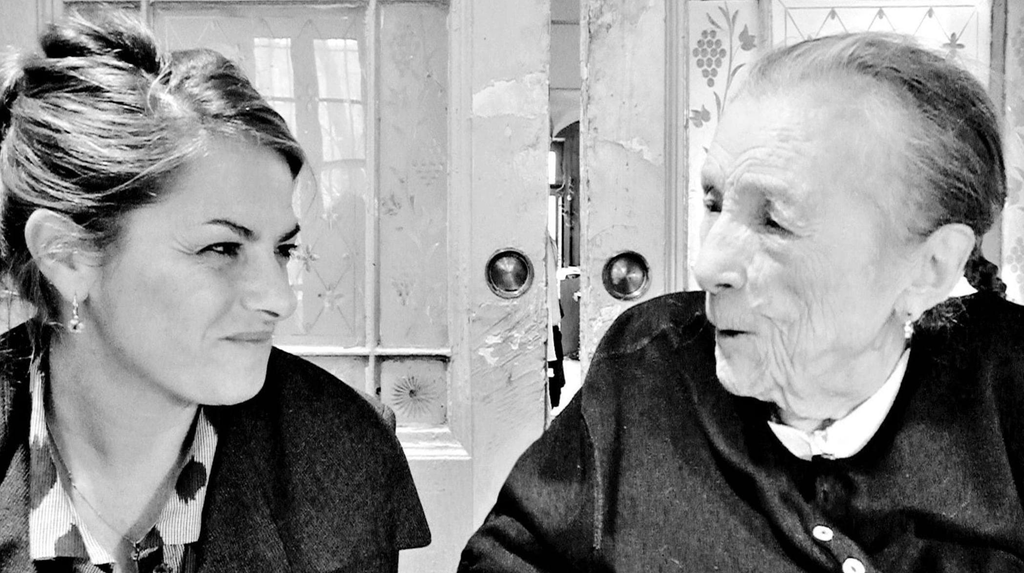
A major inspiration was Louise Bourgeois, born in Paris. In 2009 and 2010 the two created the series Do Not Abandon Me. The title I Will Not Be Alone sounds like an answer to that plea.
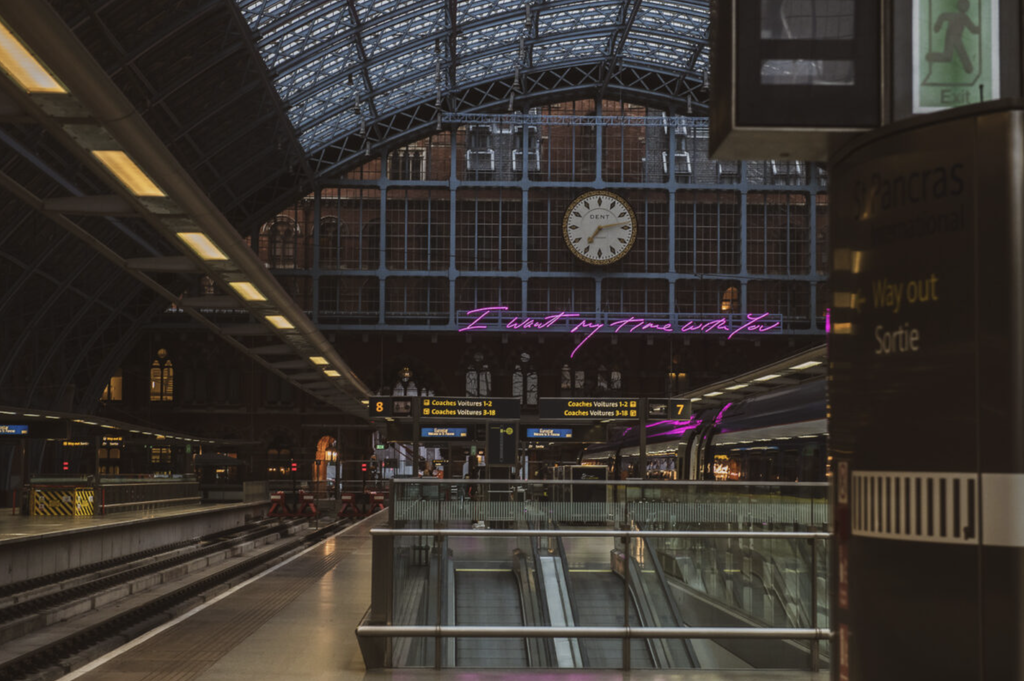
And one detail for travellers. In 2018, Emin’s largest neon, I Want My Time With You, was installed at London’s St Pancras station. Eurostar passengers arriving from Paris walked beneath it. Emin herself described it as a love letter to Europe in the time of Brexit. Now she is sending a reply in the opposite direction.
Tracey Emin at White Cube Paris and Art Basel
At the same time, White Cube opens her first solo exhibition at its Paris gallery. It runs from 20 October to 18 December 2026 at 10 avenue Matignon. It brings new paintings and intimate bronzes.
At the fair in the Grand Palais, White Cube is at booth B34. The public can visit from 23 to 25 October. Emin’s painting Waiting For A moment of You (2025), with a reclining woman, hangs there.
Tracey Emin in Paris: practical information
- Where: Parvis des Droits de l’Homme, Place du Trocadéro, 75016 Paris
- When: 14 October to 1 November 2026
- Admission: free, outdoors
A monument to survival
Thirty years ago Emin exhibited her bed and Britain laughed. Today her body in bronze sits on the most famous square in Paris. In between she has survived scandals, cancer and her own legend. Tracey Emin in Paris changes the meaning of the whole square. Her women do not stand on pedestals. They lie, kneel and sit right among us.m námestí Paríža. Medzitým prežila škandály, rakovinu aj vlastnú legendu. Tracey Emin v Paríži mení význam celého námestia. Jej ženy nestoja na podstavcoch. Ležia, kľačia a sedia priamo medzi nami.