Lucio Fontana once painted a canvas with the words “I am a saint.” On the back, he added a second line: “I am a wretch.” This exact work opens Tragicomica, the most ambitious exhibition MAXXI has ever dedicated to the history of Italian contemporary art.
The exhibition brings together more than 130 artists and 300 works. Curators Andrea Bellini and Francesco Stocchi pose a simple question through it. Why, when it comes to the biggest dramas, do Italians laugh so readily?
An Idea Thirty Years in the Making
Bellini admits the first spark for this exhibition came a long time ago. At the time, he was a philosophy student at the University of Siena. In fact, in 1996, a freshly published book by philosopher Giorgio Agamben landed in his hands. From that point on, he waited for the right place and moment to turn the idea into an actual exhibition. In total, it took thirty years.
MAXXI president Maria Emanuela Bruni opens the exhibition with a quote from Charlie Chaplin. According to him, life is a tragedy when viewed up close, but it becomes a comedy the moment you step back. Similarly, Italian filmmaker Mario Monicelli once formulated a related thought, saying that comedy is simply tragedy viewed from behind.
The Philosopher Who Named the Italian Soul
Behind the concept of the exhibition stands the very philosopher mentioned above, Giorgio Agamben. In his 1996 book Categorie italiane, he described a phenomenon he called a “stubborn anti-tragic intention.” Admittedly, it sounds complicated, but in reality, it describes one thing. Italians, according to him, systematically reject tragedy as a mode of thought.
Agamben reaches all the way back to Dante. He points out that the Divine Comedy doesn’t carry the word “tragedy” in its original title. It’s simply called Comedìa. Dante understood his journey through hell, purgatory, and paradise as a movement from guilt toward innocence, the exact opposite of how classical tragedy functions. According to Agamben, this isn’t a coincidence. It marks one of the first moments when the Italian relationship to comedy becomes a conscious cultural choice, rather than a random joke.
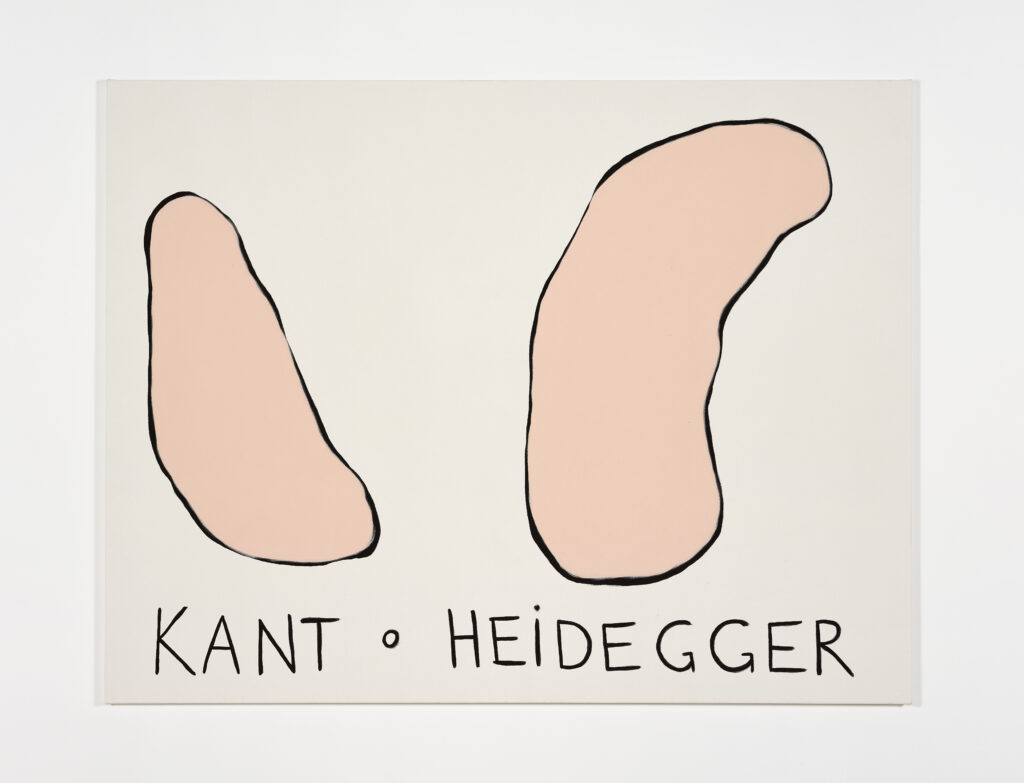
It’s also worth noting how Bellini compares this Italian sensibility to that of Northern Europe. While Italian art, since the Renaissance, has leaned toward harmony, beauty of form, and a rejection of tragedy, Northern European masters like Hieronymus Bosch, Albrecht Dürer, and Jan van Eyck instead focused on physical suffering and dark, grotesque detail.
The Work That Divided the Vatican
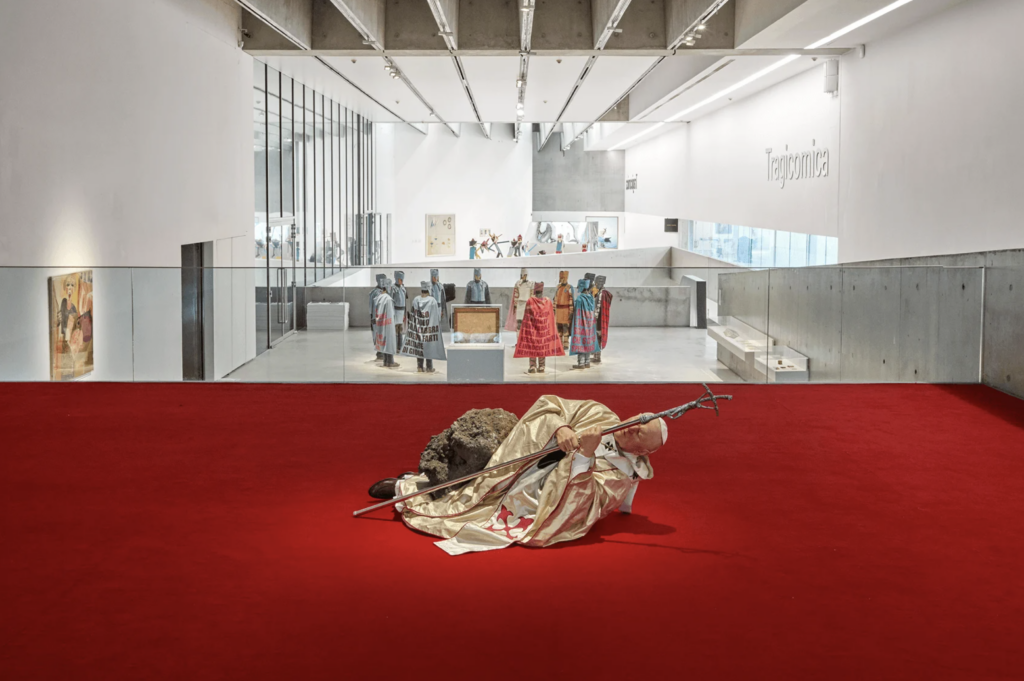
The exhibition doesn’t settle for theory alone. It also presents concrete proof of just how far this irony can go. In his work La Nona Ora, Maurizio Cattelan depicted the Pope struck by a meteorite. When the piece first debuted, it sparked a genuine scandal, including direct reactions from the Vatican.

Piero Manzoni’s work follows a similar trajectory. His cans, titled Merda d’artista, literally “artist’s shit,” emerged as a sarcastic commentary on the art market. Today, those same cans sell at auction for hundreds of thousands of euros. Irony itself became a commodity, exactly what it once set out to criticize.
A Horse, a Swing, and 25,000 COVID Jokes
The exhibition path doesn’t follow a chronological order. Instead, works enter into dialogue with each other across decades. Right at the entrance, visitors encounter Fontana’s canvas, set against Elena Bellantoni’s armed warriors, weapons made entirely of words.
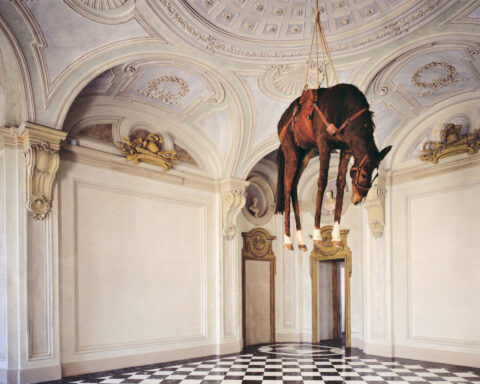
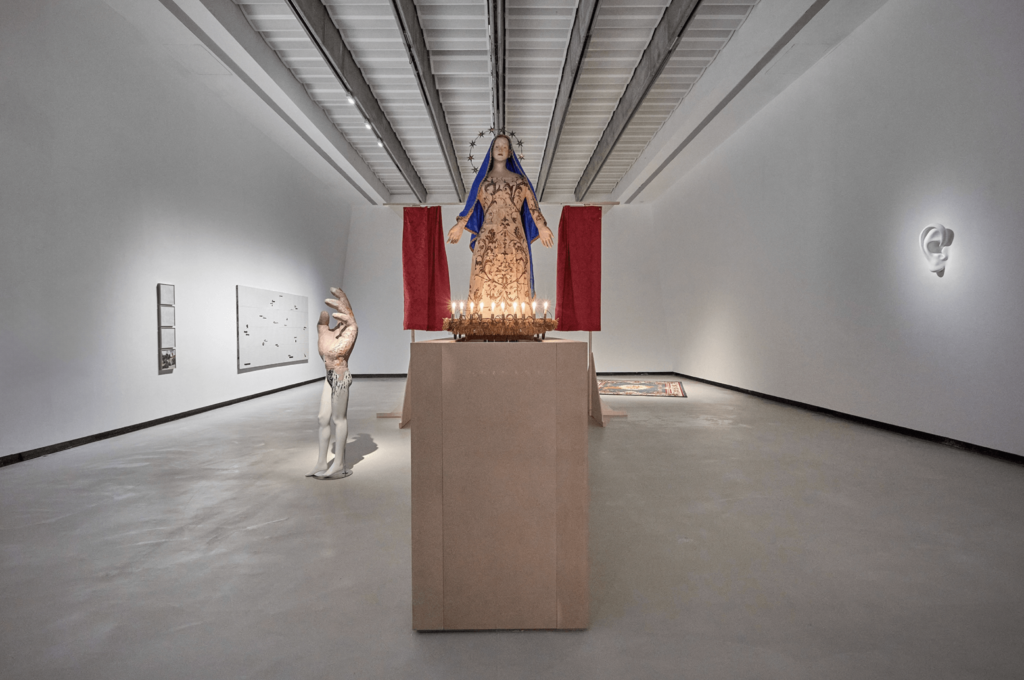
Further along the route waits Alighiero Boetti’s Annual Lamp, which lights up for only a few seconds, once a year. Monica Bonvicini’s neon sign, Built for Crime, signals the entrance into the exhibition’s second section, where the space shifts from open to denser and more compressed. Cattelan’s suspended horse, titled Novecento, or Twentieth Century, stands in dialogue with works by Luciano Fabro, in a confrontation between monumentality and irony.

Chiara Fumai appears suspended on a swing in her piece The Night Is Still Young, dressed as a princess, immersed in a fairy tale atmosphere. Beside her hangs Paola Pivi’s mosaic, assembled from 25,000 jokes and memes about COVID, which the artist collected throughout the pandemic. Piero Manzoni also appears through his Living Sculpture, where visitors themselves become part of the work the moment they step onto the pedestal.
Women Who Took Up Laughter as a Weapon
The exhibition also devotes significant space to women artists who used grotesque humor and irony as tools of political resistance. Among them are Ketty La Rocca, Tomaso Binga, and the aforementioned Chiara Fumai. Their work presents body and language as a space where patriarchal authority can be mocked, not just critiqued in a serious tone.
Sixteen Years Waiting for This Moment
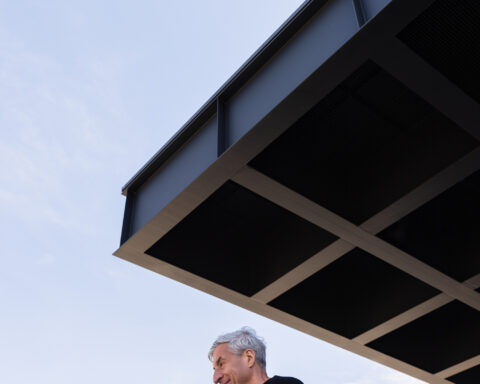
The exhibition takes place inside the MAXXI building, designed by architect Zaha Hadid and opened in 2010. Sixteen years after opening, the museum maps its own national scene this generously for the very first time. Francesco Stocchi, MAXXI’s artistic director since 2023, curated the exhibition. Standing alongside him is Andrea Bellini, who also curated the Swiss Pavilion at the Venice Biennale in 2024.
If You’re Going
Tragicomica runs at MAXXI in Rome from April 2 to September 20, 2026. The exhibition is accompanied by a rich program of talks, film screenings, and readings, including an Italian film series curated by Davide Oberto.
A substantial catalogue accompanies the exhibition, published by Marsilio Arte, running 568 pages with 217 color illustrations. It’s available in both Italian and English editions, priced at 47 euros.