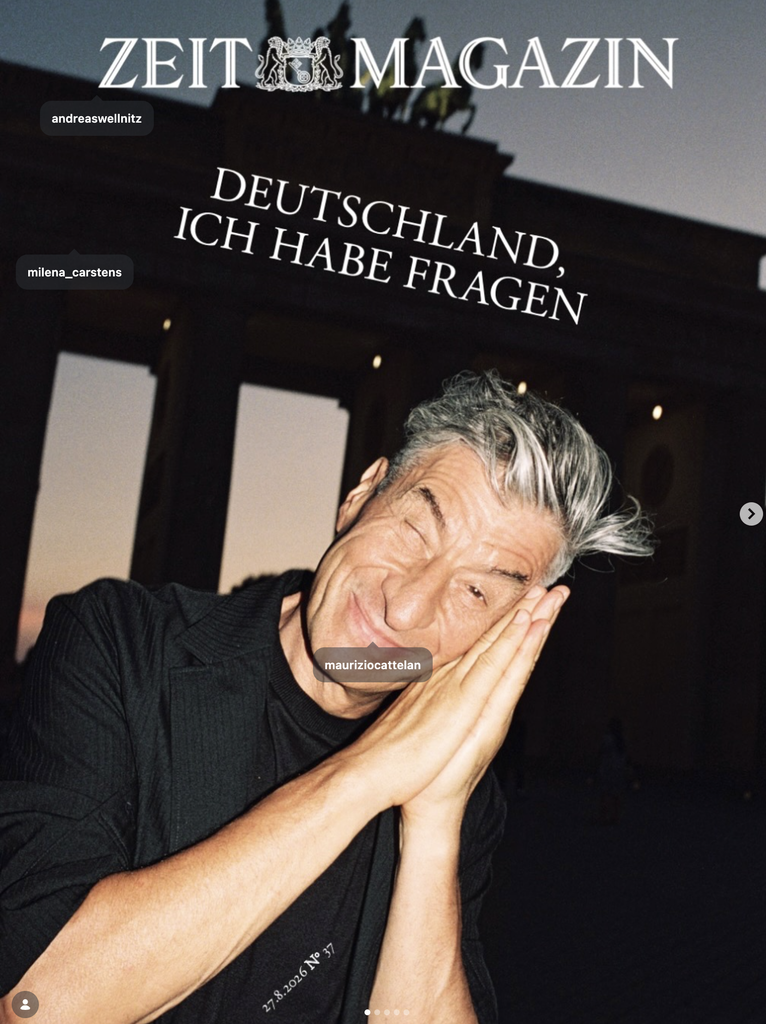
Neue Nationalgalerie in Berlin presents NIGHT, the first major solo exhibition in Germany by Italian artist Maurizio Cattelan. The exhibition also forms the 2026 Preis der Nationalgalerie, for which an international jury selected Cattelan. It runs from September 10, 2026, to March 7, 2027.
Who Is Maurizio Cattelan
The Italian artist was born in 1960 in Padua. Since the early 1990s, he has been one of the most striking voices in international art. His work draws on familiar, almost fixed images. He shifts them just enough to unsettle their established meaning. He touches on subjects often considered difficult: religion, childhood, authority, collective generational trauma. Cattelan returns to Berlin after twenty years. He previously co-curated the 4th Berlin Biennale here.

Building That’s a Monument in Its Own Right
The Neue Nationalgalerie was completed by Mies van der Rohe in 1968. It’s the only building he ever built in Europe after his emigration to the US. In a formal sense, it marks the culmination of his entire creative career. It can be read as an enlarged version of his famous Barcelona Pavilion.
The building underwent a massive, six-year renovation between 2015 and 2021. It was led by British architect David Chipperfield, at a cost of around £120 million. In the process, more than 35,000 original components had to be dismantled and reassembled. These included 2,500 square meters of stone cladding. Chipperfield chose a simple motto: as much Mies as possible. The British newspaper The Guardian nonetheless described the building as a breathtaking architectural icon. At the same time, it called it hopeless for actually displaying art, since Mies had prioritized purity of form over practical function.

It’s into this very space, designed as an almost sacredly empty, pure form, that Cattelan now inserts his site-specific installation. He changes how the building is used and experienced altogether.
What You’ll See
The exhibition brings together key historical works with new commissions. You’ll find Him (2001), Novecento (1997), and La Rivoluzione Siamo Noi (2000). Also included is Untitled (2003), inspired by Günter Grass’s The Tin Drum.
A Kneeling Figure and a Gesture from 1970
A Kneeling Figure and a Gesture from 1970
The work Him depicts a kneeling child-sized figure with Hitler’s face. Museum director Klaus Biesenbach reads it through an entirely different historical lens. It reminds him of the Kniefall von Warschau, the kneeling gesture made by German Chancellor Willy Brandt in 1970.

Brandt, during a state visit to Poland, laid a wreath at the memorial to the Warsaw Ghetto Uprising. Unexpectedly, with no plan, he knelt before it. He remained silent in that position for about thirty seconds. He himself was the first Social Democratic chancellor of postwar Germany, having spent most of Hitler’s rule in exile. The gesture became a worldwide symbol of Germany’s effort to reconcile with its eastern neighbors. At home, it was surprisingly controversial at the time; nearly half of Germans rejected it.
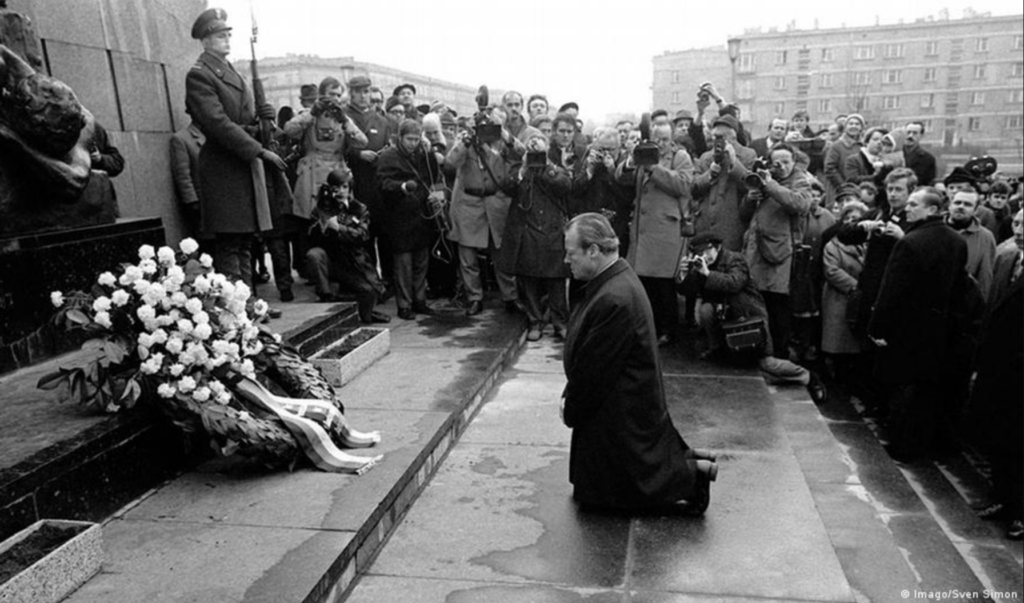
According to Biesenbach, Cattelan’s work places two opposing images of kneeling side by side. One belongs to a perpetrator, the other to a man asking forgiveness on behalf of his nation. The little drummer boy in another work comes directly from Grass’s novel. Biesenbach even recalls that one of his first encounters with the art world was Joseph Beuys’s felt suit, since he grew up just a few miles from the center of Beuys’s activities.
Why the Exhibition Is Called NIGHT
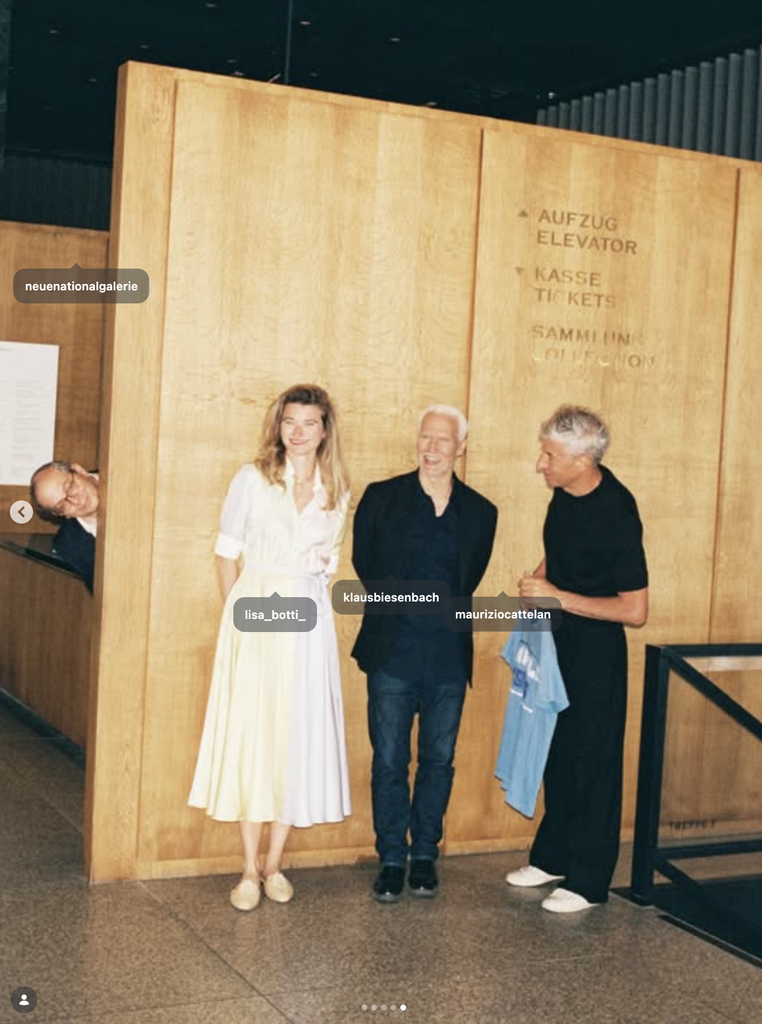
Curator Lisa Botti explains that the exhibition developed through close collaboration with Cattelan over an extended period. This included repeated visits to Berlin. The title NIGHT, she says, suggests a condition in which things aren’t necessarily hidden, just perceived differently. In the dimmed light of evening, familiar forms can become strange. Overlooked details, meanwhile, come into focus.
The History of the Prize
The Preis der Nationalgalerie was founded by the FREUNDE der Nationalgalerie in 2000. Over the past 25 years, it has established itself as one of Germany’s most significant awards for contemporary art. In 2026, the prize enters a new phase. It moves directly into the iconic glass hall of the Neue Nationalgalerie. This makes it a singular opportunity for an artist to realize a focused, ambitious presentation.
The jury for 2026 included Emma Lavigne, director of the Pinault Collection in Paris, and Sam Keller, director of the Fondation Beyeler in Basel. The third member was Klaus Biesenbach, director of the Neue Nationalgalerie itself. The exhibition is supported by BMW.
Where and When
Maurizio Cattelan. NIGHT, Neue Nationalgalerie, Potsdamer Straße 50, Berlin. September 10, 2026 – March 7, 2027. Press preview on September 9, 2026, at 9 am, public opening the same day during Berlin Art Week.