In Rome, Valentino gowns stand beside paintings by Ewa Juszkiewicz. Are they just beautiful dresses and beautiful paintings? Aura, the third exhibition at PM23, the cultural venue of the Fondazione Valentino Garavani e Giancarlo Giammetti on Piazza Mignanelli, shows that the answer is more complex.
Who is Ewa Juszkiewicz
Ewa Juszkiewicz (1984) is a Polish painter. Born in Gdańsk, she lives and works in Warsaw. She studied painting in Gdańsk and earned her doctorate at the academy in Kraków. She is represented by Gagosian and Almine Rech. Her painting Portrait of a Lady (After Louis Leopold Boilly) (2019) sold at Christie’s in 2022 for 1.56 million dollars, her auction record.
Portraits without faces
Since 2011, she has painted after historical portraits of women from the Renaissance to the 19th century. She preserves the style and technique of the original precisely, but covers the face. Sometimes with fabric, sometimes with braids, flowers, fruit or mushrooms. The painting stays beautiful, but it stops being comfortable.
Why it is not just a pretty picture
Old portraits depicted women according to a male ideal of beauty. Poses, gestures and expressions repeated themselves. Juszkiewicz covers this ideal and leaves it to the viewer to notice what is missing.
The flowers and fruit on the faces are not mere decoration. They refer to women painters of the 17th and 18th centuries who were not allowed to study the nude and therefore turned to still life. Their work long remained on the margins of art history.
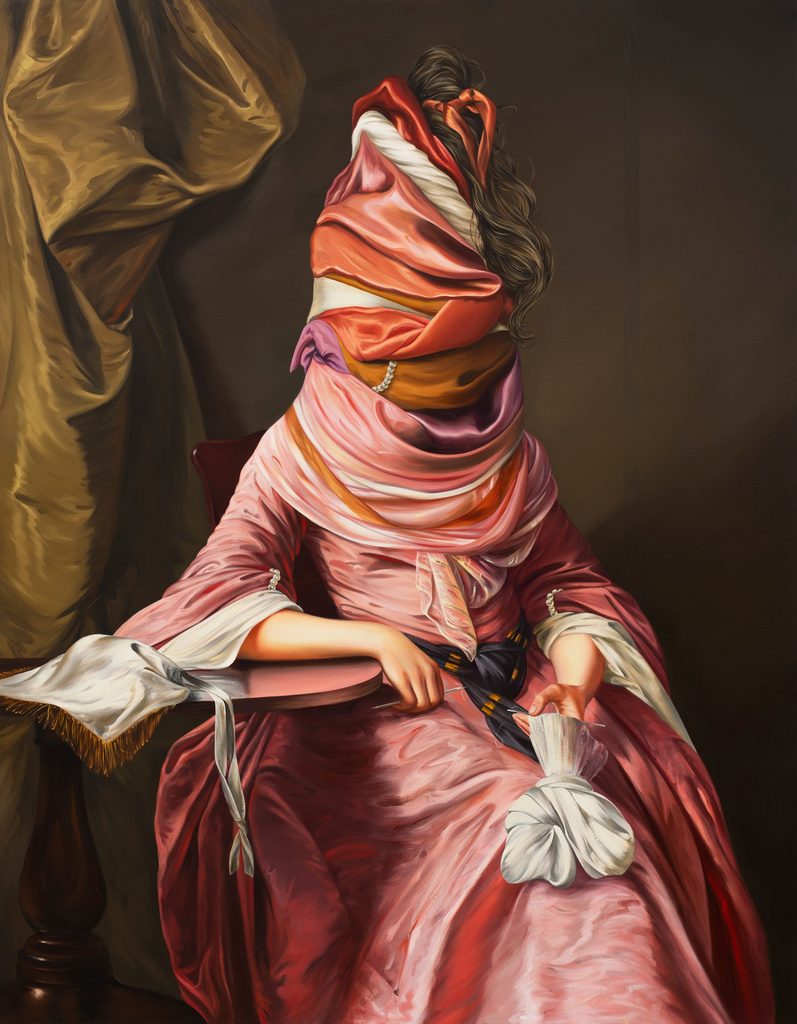
Fashion matters too. Juszkiewicz grew up in Poland in the early 1990s, when the streets were grey and fashion magazines felt like a window into another world. For her, fashion meant freedom. Yet the corsets and crinolines in old portraits dictated how women could move and sit. In her paintings, clothing is both ornament and discipline.
Then there is the question of original and copy. She paints from reproductions and refers to Walter Benjamin and his reflections on the aura of the work of art. She turns a copy into a new original. She also draws on Surrealism, on Leonora Carrington and Eileen Agar, and on Cindy Sherman’s History Portraits. For her, absurdity and humour are a form of protest against stereotypes.
How she works
First, she searches art history for a portrait that embodies convention. Then she builds a real object or mask from wigs, fabrics, old jewellery and plants, and paints from it. She applies oil in many layers and glazes, sometimes spending weeks on a single detail..
Aura: paintings and Valentino gowns
The exhibition follows her first solo museum exhibition at the Museo Nacional Thyssen-Bornemisza in Madrid (May – September 2026). In Rome, the same paintings appear in a new context. Juszkiewicz spent the summer in the Valentino archive, finding a gown for each painting.
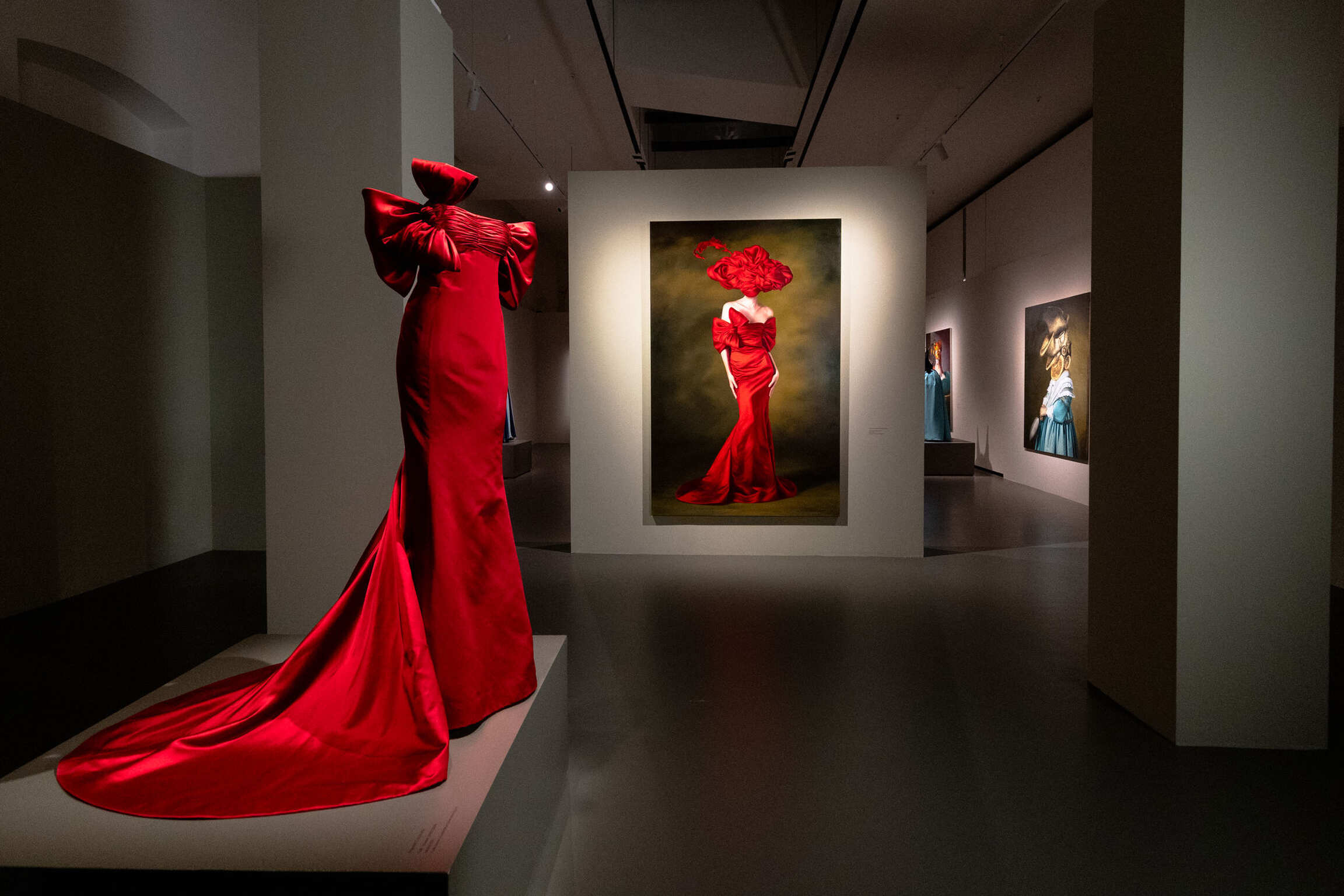
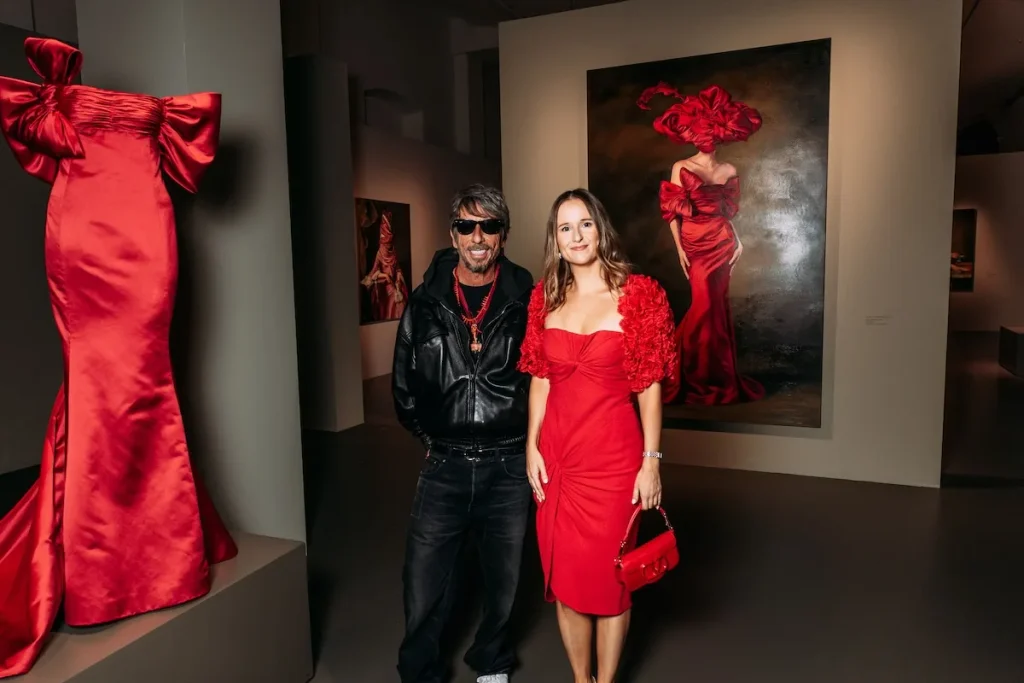
At the entrance stands a red gown from the Autumn/Winter 2007–08 Haute Couture collection. Beside it hangs A Portrait in Valentino Red, a painting Juszkiewicz made especially for the exhibition. The woman’s face is covered by a formation of red fabric with a palm-leaf motif, something between a rose, a bow and a growing plant. On canvas, the dress becomes sculpture.
In another painting, lustrous white fabric wraps around the head, next to a gown covered in feathers. Leaves and pink flowers on a face echo the fern-like patterns of the gowns. Girl in Blue (2013), with mushrooms growing in place of a head, stands beside a gown with a turquoise skirt.

The exhibition brings together 38 gowns from the Valentino archive and 26 paintings. Juszkiewicz says she is drawn to Valentino’s vision of femininity, which moves between delicacy and strength, with the woman at its centre keeping a self-assured presence. She describes the exhibition as a story of transformation.
Next to the paintings, the gowns are no longer just clothes. They are an image of a woman that someone designed, just like the portraits Juszkiewicz starts from.
Giancarlo Giammetti says the exhibition set out to explore how fashion and art can change the way we see beauty. That is the answer to the opening question: it is not about beautiful dresses or beautiful paintings, but about who decides what is beautiful, and why.
Practical info
Aura: Valentino Garavani – Ewa Juszkiewicz
PM23, Piazza Mignanelli 23, Rome
18 October 2026 – 21 February 2027
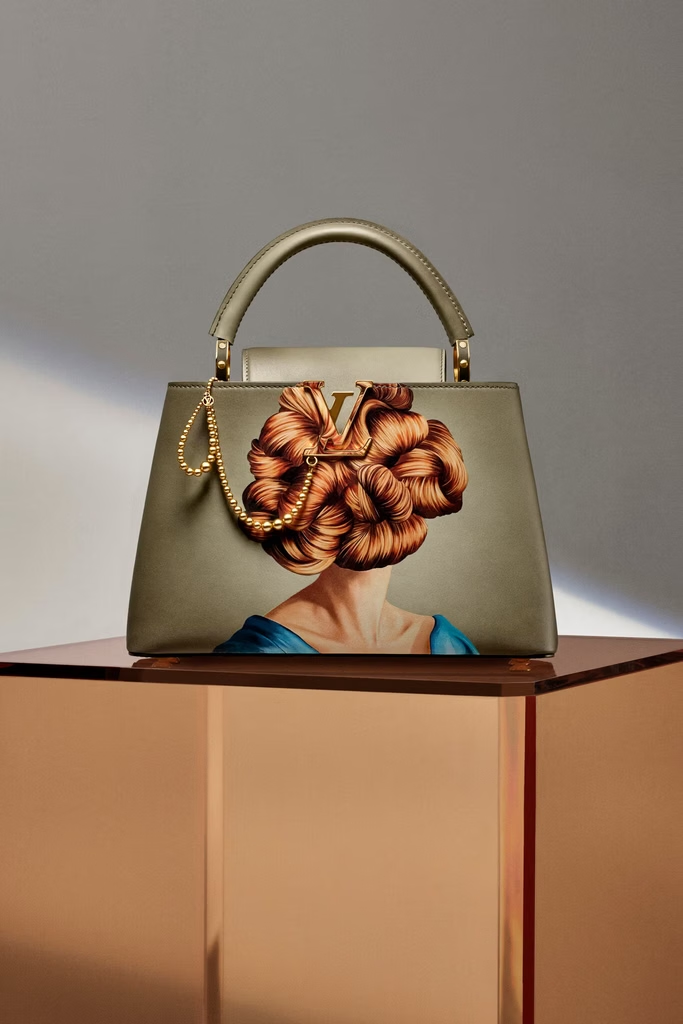
Louis Vuitton Capucines bag featuring Ewa Juszkiewicz’s painting Ginger Locks, Artycapucines 2023 collection. Photo: Louis Vuitton