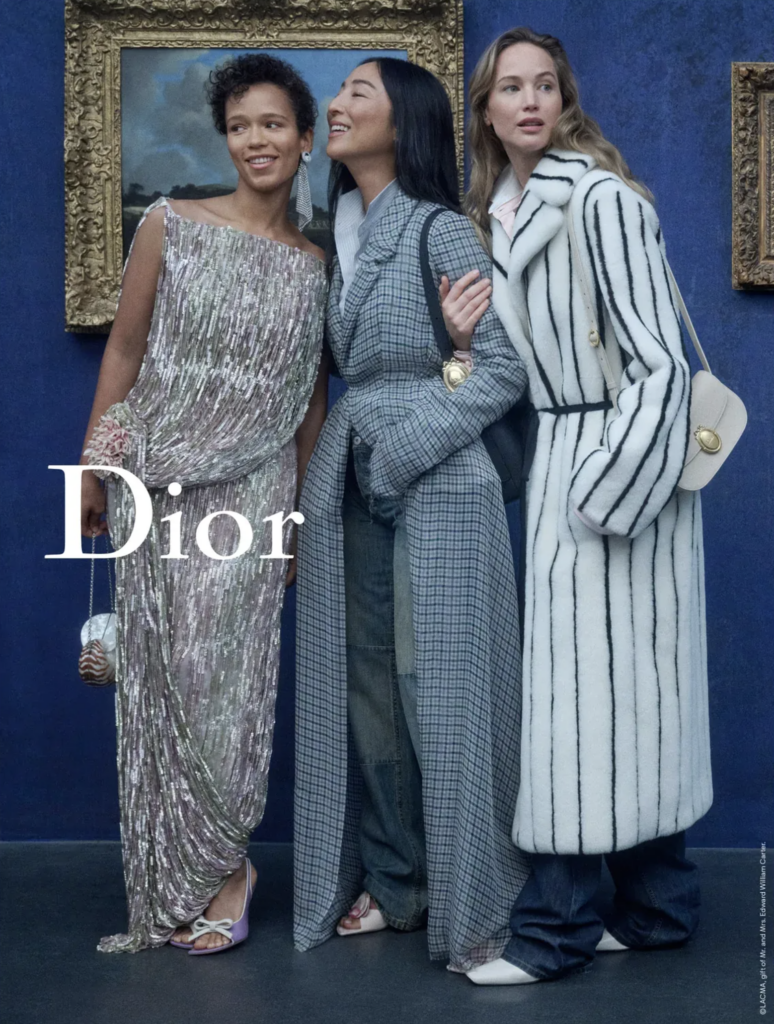
The Dior Cruise 2027 collection now has a campaign to go with its show. Sam Rock photographed it at the Los Angeles County Museum of Art, known as LACMA, in the same building where the show took place in May. That building is the reason the campaign is worth a second look.
A Building Turned Stage
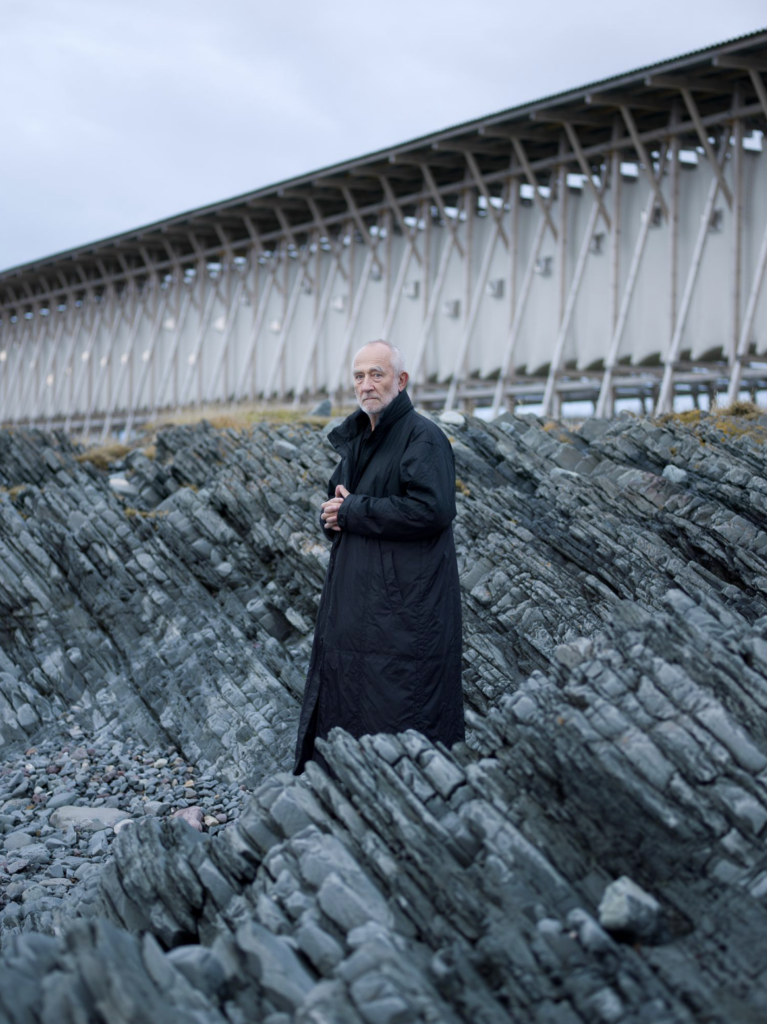
LACMA is the Los Angeles County Museum of Art, on Wilshire Boulevard. Its newest part is the David Geffen Galleries. The Swiss architect Peter Zumthor designed it. He won the Pritzker Prize in 2009. Zumthor was born in Basel in 1943 and trained as a cabinetmaker in his father’s workshop. That background shows in his focus on craft and material. This is his first building in the US. It is also the largest project he has ever built, at more than 32,000 square metres including outdoor space.
The building arches over Wilshire Boulevard, so traffic passes beneath it. It replaced four older buildings, among them three by William Pereira from 1965. Completed in April 2026, it cost roughly $720 million, $125 million of it public funds and $595 million from private donors.
It has been contested from the start, because it offers less gallery space than the buildings it replaced. The Los Angeles Times critic Christopher Knight called LACMA “the Incredible Shrinking Museum”.

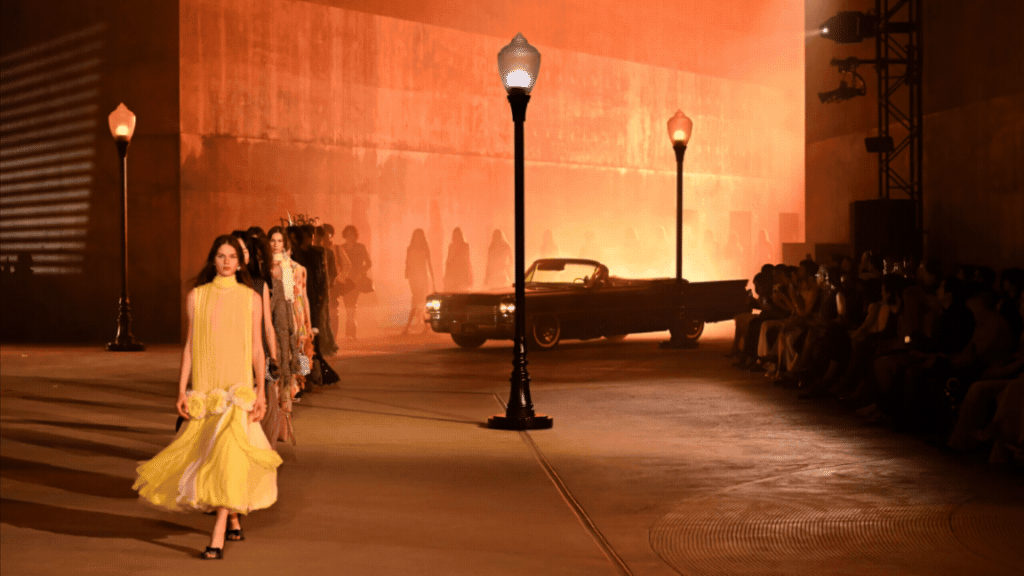
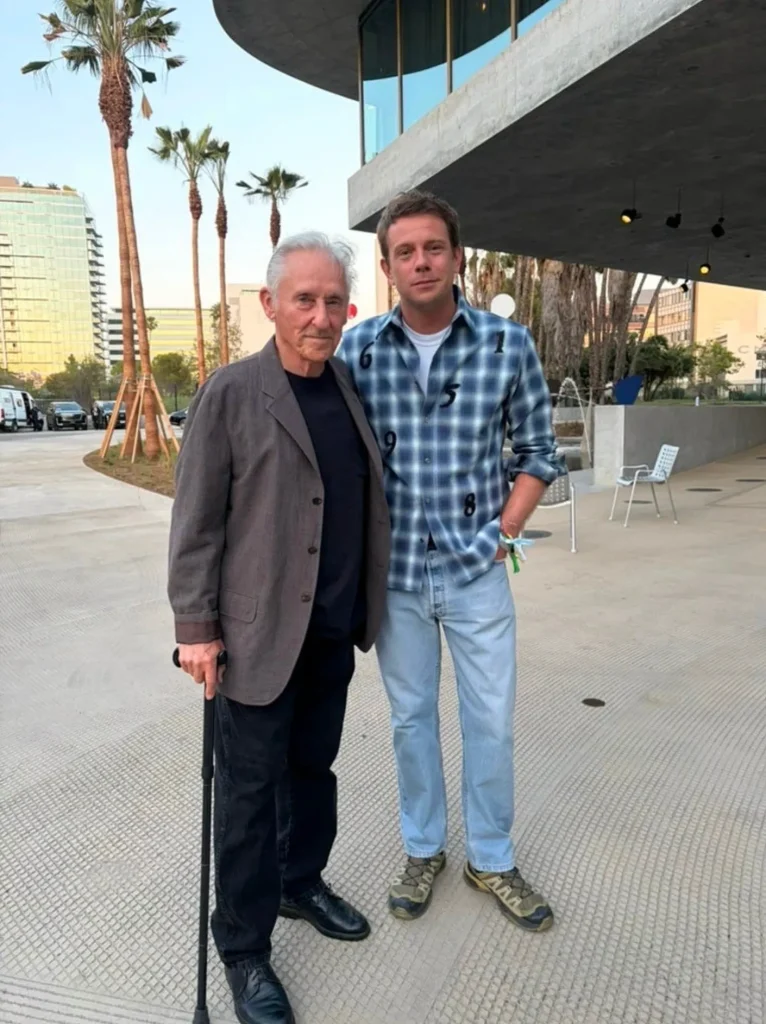
Since then, the museum has been used as a stage. In May, Dior showed its cruise collection here, and in June Jeffrey Deitch brought his Art Parade to Wilshire Boulevard beside the new galleries. On 27 September, the poster for the film Digger by Ed Ruscha was unveiled here, and now the campaign has been shot here too.
Light and Shadow
Zumthor builds with light. Glass wraps the upper level from floor to ceiling, so daylight enters from every side, while some enclosed galleries have only a narrow slit under the ceiling and many have no daylight at all. When the project was approved in 2019, Brad Pitt told the hearing: “You really have to stand in them to see his mastery of light and shadow.” We write about this in the piece on Wim Wenders’ documentary about Zumthor.
The May show matched that. Jonathan Anderson staged it as a film noir, with vintage American cars, street lamps, film fog and shadows on concrete walls. The starting point was a haute couture jacket from 1949 worn by Marlene Dietrich in Stage Fright, in which she insists on wearing Dior. Film noir is a genre built on light and shadow, and Zumthor’s building is its concrete version. We describe the whole show in our May article.
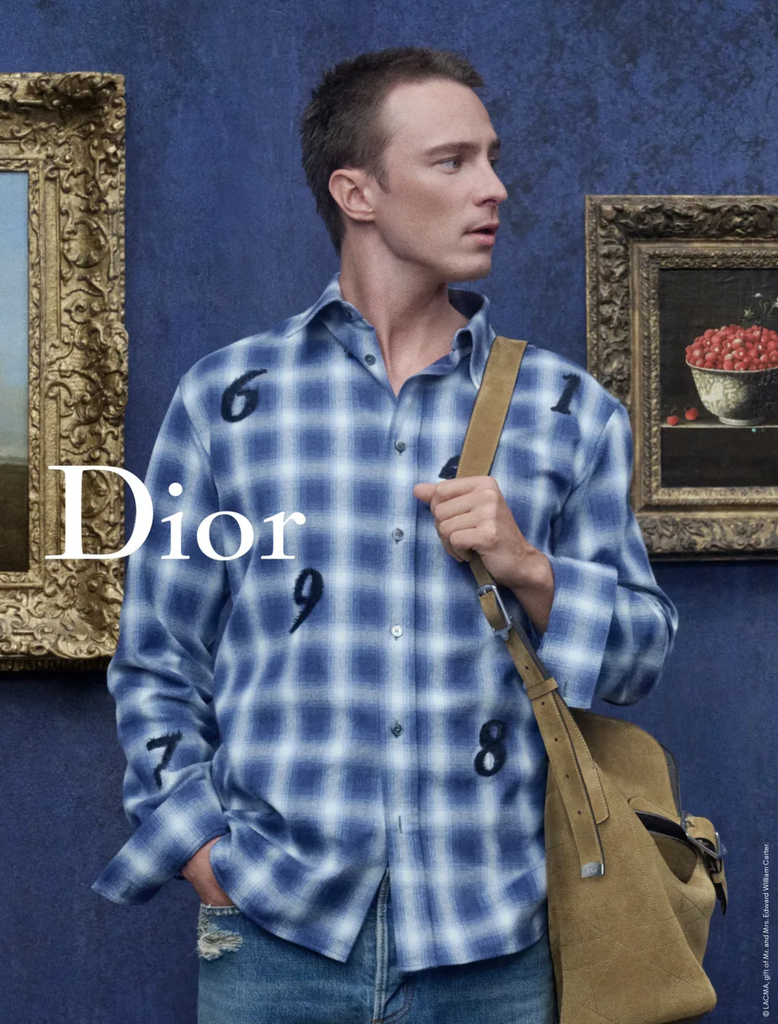
The campaign turns the same logic around. The shadows on the walls are replaced by paintings that the guests look at. Jennifer Lawrence, Greta Lee and Taylor Russell wander through the galleries, and Drew Starkey, “found in artistic contemplation” according to Dior, explores the museum. In its credits Dior lists Monet’s Water Lilies from the gift of A. Jerrold Perenchio and a still life by Adriaen Coorte from the gift of Mr. and Mrs. Edward William Carter. According to WWD, a landscape by Jacob van Ruisdael also appears. This month, Monet is also in Paris, at the Musée de l’Orangerie, where the exhibition Monet, Painting Time marks the 100th anniversary of his death.
A Gift Behind the Paintings
The paintings in the campaign are not random backdrops. LACMA has Coorte and other Dutch paintings from the campaign thanks to Edward William Carter, who helped create the museum as an independent institution in 1965 and was the first president of its board. With his wife Hannah, he gave the museum a collection of 36 17th-century Dutch paintings in 2009, mostly landscapes and still lifes. It includes, for example, Ruisdael’s View of Grainfields with a Distant Town from around 1670 and Coorte’s Strawberries in a Chinese Porcelain Bowl from 1704.
Text on the Body
In the campaign, Drew Starkey wears a shirt from Dior’s collaboration with Ed Ruscha. We saw the same shirts on the runway in May, with lettering and a reference to Ruscha’s 2024 painting Says I, to Myself, Says I. Ruscha also designed the poster for the film Digger. In less than a year he has gone from canvas to runway, to film poster, and finally to a fashion campaign, always in the same building.
Dior and the Gallery
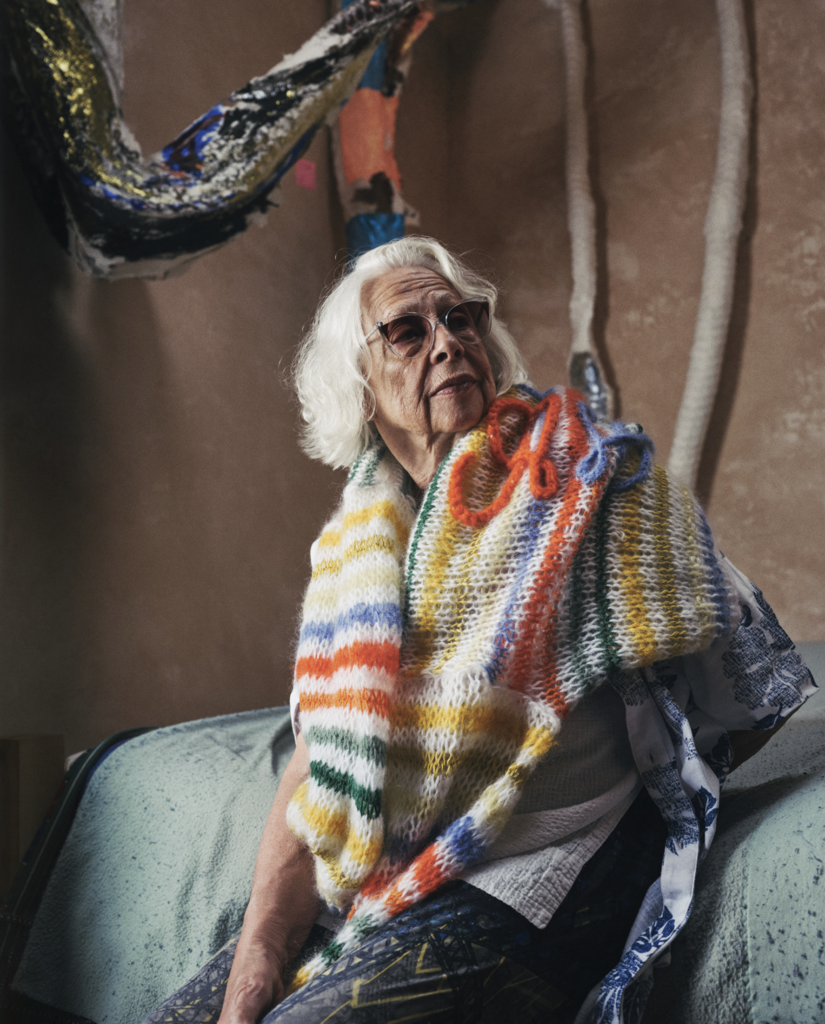
For Anderson, Ruscha is not an exception. In July, Dior built its haute couture collection on the work of Lynda Benglis. Her sculpture Kissel turned into a silver pleated cocktail dress on the runway, as we write in Lynda Benglis’s Year. Christian Dior himself once exhibited Braque, Matisse, Picasso, Dalí and Bérard in his galleries. A curiosity: the Lady Dior has been reinterpreted by the textile artist Sheila Hicks, whom Dior wrapped in hand-bound tassels of linen and silk.

Set, or Reason?
The campaign shows people looking at art, in a building that is itself a work of art, in clothes built on art. Does the museum help a fashion brand say something about art, or does art help the brand say something about itself? The campaign does not answer that on its own. What do you think?
The collection will be available in selected stores and on Dior.com from 22 October.
Sources: The Art Newspaper, Architectural Record: LACMA, Dezeen, 2019, Architectural Record: Pritzker 2009