The art world has lost one of its most striking figures. Yayoi Kusama has died at the age of 97. Critic Blake Gopnik described her in The New York Times as an artist who, over her long life, experienced two entirely different waves of fame, almost as though she had been two different artists.
The First Incarnation: New York Avant-Garde
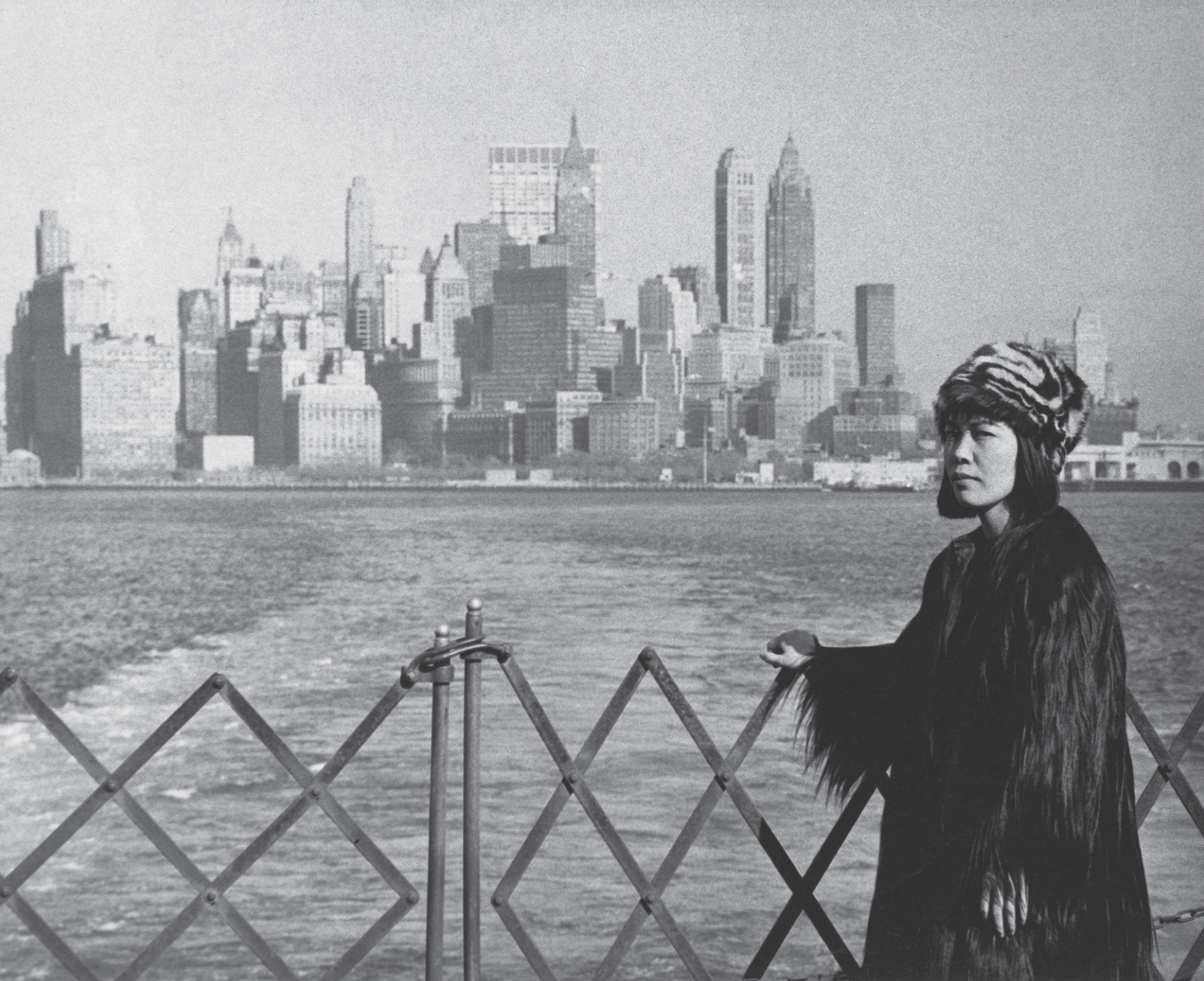
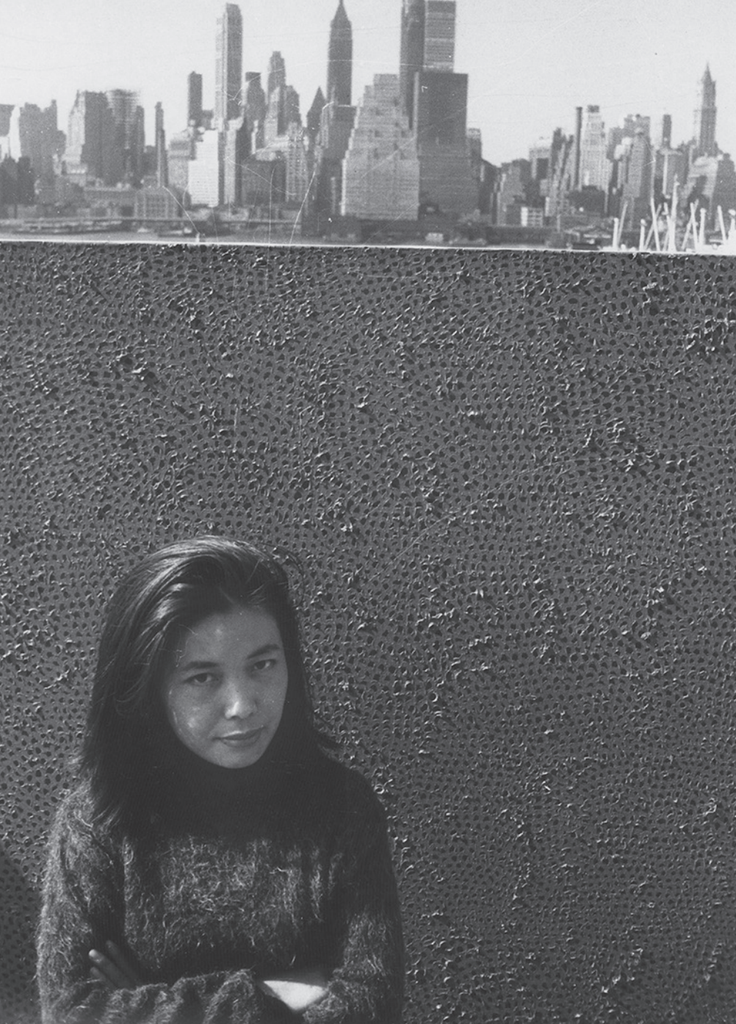
Kusama was born in 1929 in Japan, into a wealthy but deeply dysfunctional family. She moved to the United States in 1957. Within eighteen months of arriving, she had made her mark on the New York scene with large-scale canvases covered in lines and dots, now known as “Infinity Nets.”
The 1962 exhibition at Green Gallery became legendary. It’s now considered one of the most prophetic group shows of its time, since it featured the work of three artists who would each go on to become defining names, in their own distinct ways: Warhol (Pop Art), Morris (Minimalism), and Kusama.
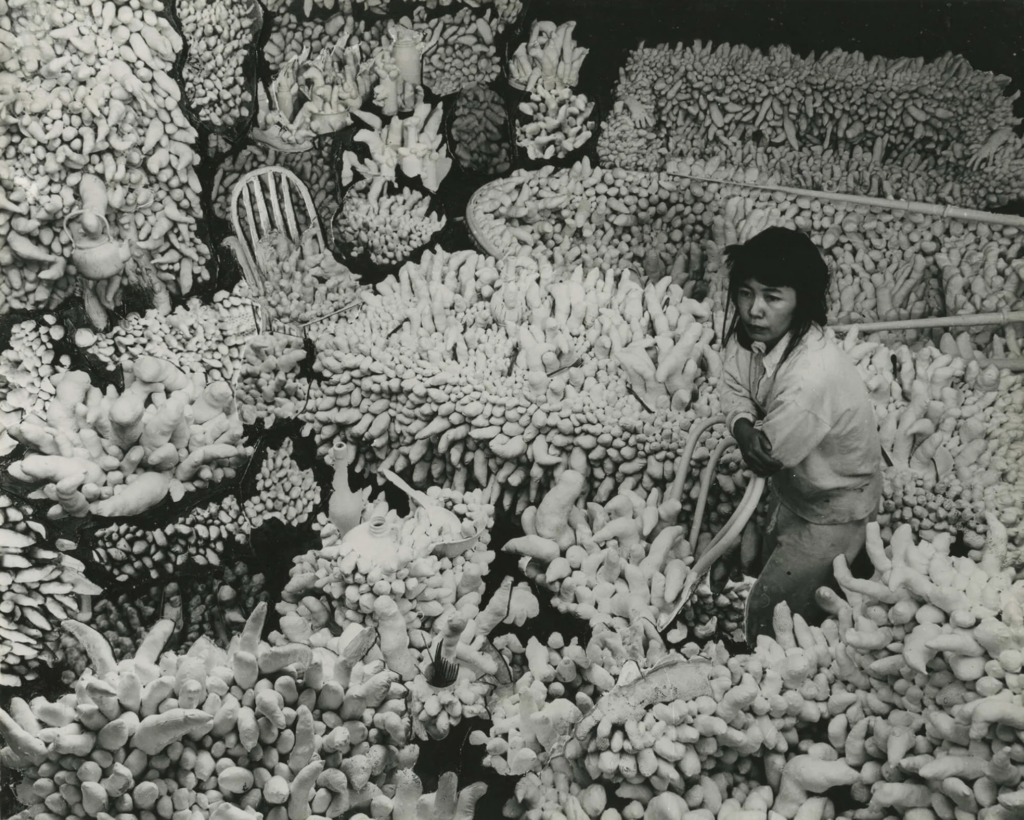
Yet Kusama overshadowed both men. Her sofa, covered in hundreds of stuffed, phallic-shaped protrusions, was described by the press at the time as looking like it had “broken out in thousands of white growths.” In reality, these were cloth penises, too bold for the newspapers of the era to name directly.
Her later “Accumulations” series covered ordinary objects with the same protrusions, from a rowboat to an ironing board to shoes. Today, these count among the earliest feminist artworks, deliberately depicting a world literally overrun and infested with symbols of maleness.
A Forerunner of the Artist as Celebrity
Kusama was ahead of her time in another way, too. Before Warhol became known for cultivating his own eccentric image as part of his art, she was already doing exactly that. She made sure to always be part of the photographs of her own work, sometimes posing nude and covered in dots. She later became known for her own performance pieces, in which she painted her signature dots directly onto the naked bodies of the hippie generation.
Yayoi Kusama and Georgia O’Keeffe: the Letter That Changed Everything
Their relationship, however, didn’t stop at a single exchange of letters. Kusama later admitted to Tate that if O’Keeffe hadn’t so kindly replied to her “clumsy and reckless” letter, she probably never would have made it to America. She knew one thing for certain: she could only become a star in New York.
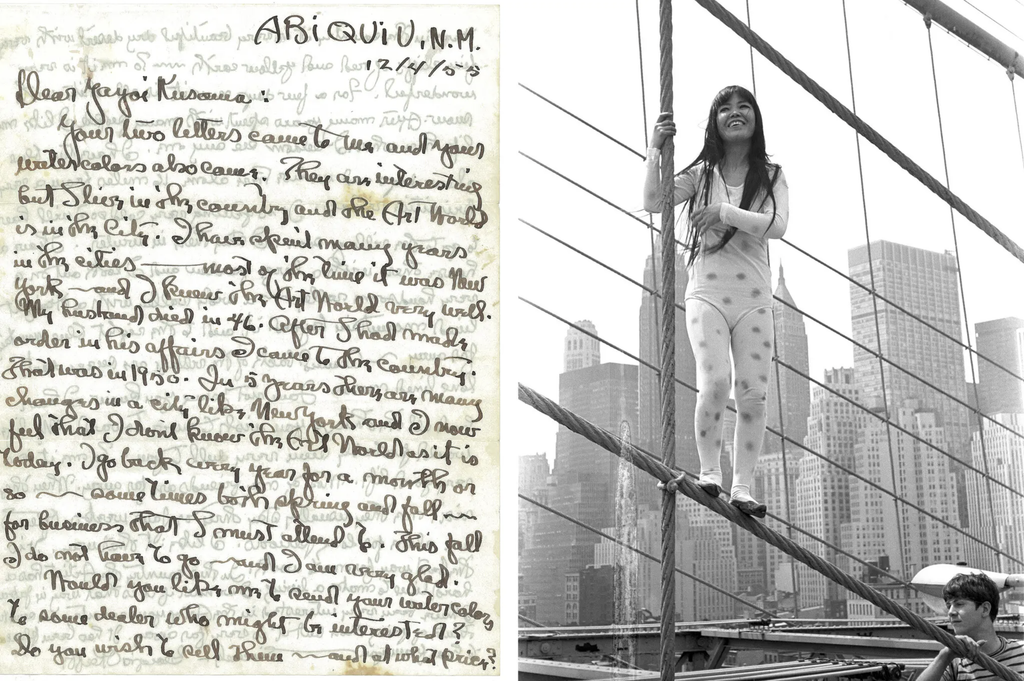
The two artists, separated by 42 years in age, met in person only once. As a young artist in Matsumoto, Kusama came across O’Keeffe’s work in a book and boldly wrote to her asking for advice. O’Keeffe, intrigued by the Japanese return address, replied. She encouraged Kusama to move to New York and show her work to “anyone” who might be interested.
Over the years, O’Keeffe repeatedly invited her to visit her home in New Mexico. Kusama always declined, convinced that international recognition could only be found in New York.
Fun Facts: Kusama’s Artistic Circle
Donald Judd — her first close friend in the New York art world. In 1962, the two of them hauled an oversized armchair through the streets of Manhattan, which became the basis for her iconic work Accumulation No. 1. Judd bought a painting from her for $200, paid off in four installments, and later moved into the same building, into the loft right above hers, after she tipped him off about the vacancy. He also helped her obtain permanent residency in the US.

Joseph Cornell — the great love of her life. Twenty-six years her senior, an eccentric “king of boxes,” he lived with his domineering mother in Queens. Kusama described their relationship as “ideal”: she disliked sex, he was impotent, so, in her words, “we suited each other very well.” He called and wrote to her multiple times a day, once sending her fourteen letters in a single day. His mother once caught them embracing and poured cold water over them, shouting that “women are a disease.”

Andy Warhol, Claes Oldenburg, Eva Hesse — other members of her circle of friends from her early days establishing herself on the avant-garde scene.
Village Voice — not everyone was a fan. Reviewing one of her performance pieces, the paper wrote that Kusama had staged “the most boring freak show of the year.”
The Turning Point: Returning to Tokyo
In the early 1970s, Kusama returned to Tokyo for good. Shortly after Joseph Cornell’s death in 1972, the mental illness she had struggled with her whole life resurfaced. She voluntarily admitted herself to a private institution, where she would go on to spend most of the second half of her life. The art world barely heard from her for nearly 15 years. In 1984, one of the few articles written about her described her as merely “vaguely remembered.”
The Second Incarnation: Kusama 2.0
Her comeback in 1989 came with an entirely new narrative framing. Her illness itself became the central point of interest, overshadowing the art. Critic Roberta Smith, writing in The New York Times, described her at the time as the only psychiatric patient paying her medical bills with income earned from her art. This shift in framing, paradoxically, brought her to a far wider audience than any avant-garde gesture from the 1960s ever had.
Infinity Rooms as a Social Media Phenomenon
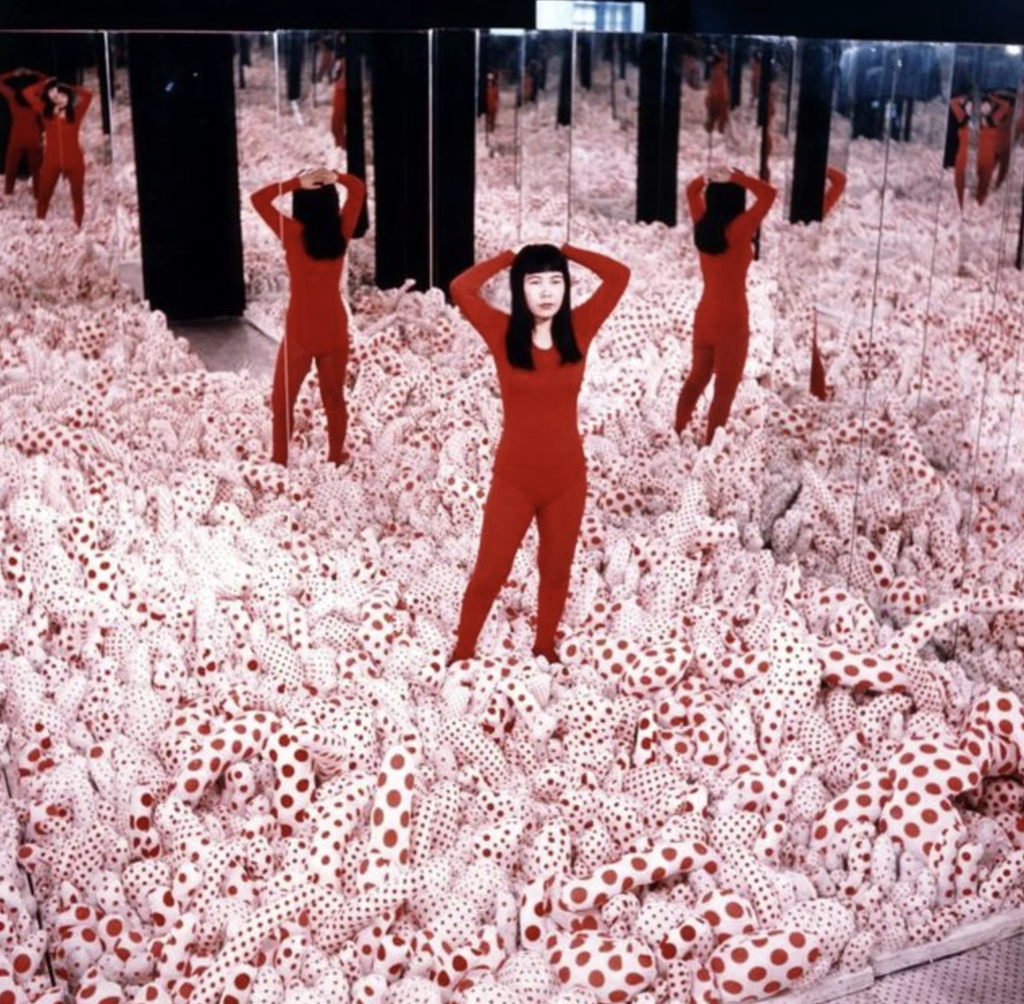
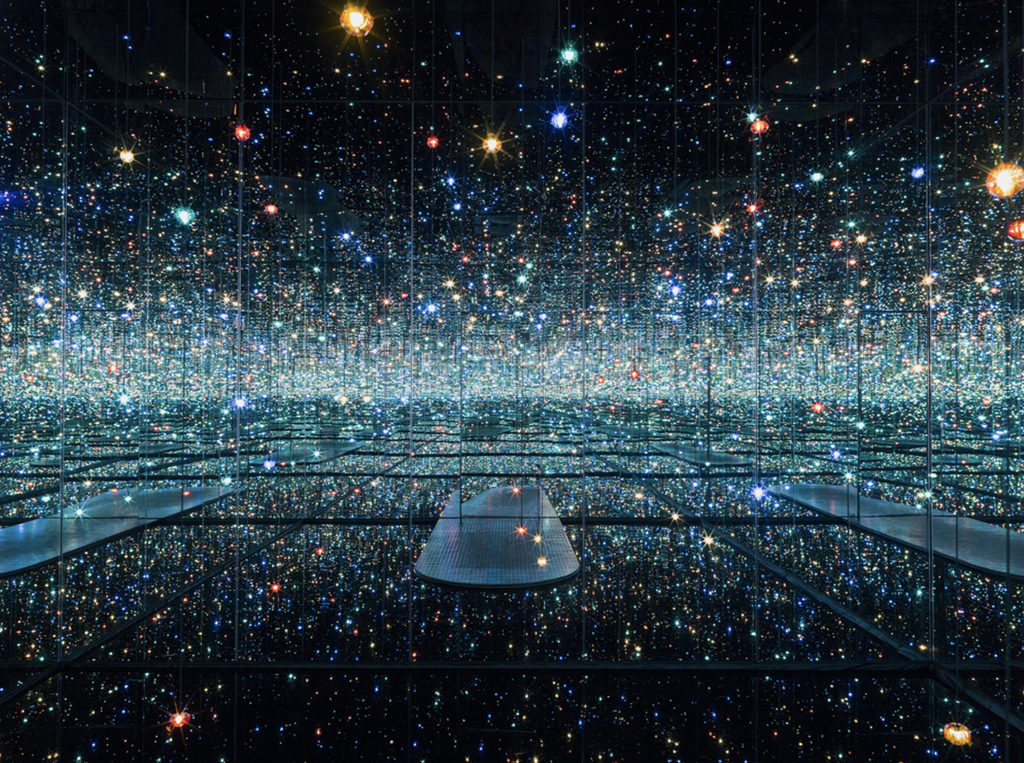
The first “Infinity Room” was created back in 1965, but it wasn’t until the 1990s that these became the centerpiece of her work. In her later years, they drew millions of visitors worldwide and became some of the most photographed artworks in existence: small mirrored spaces, entered one visitor at a time, where you see yourself reflected into infinity, and, of course, snap a photo of it.
Kusama and Mass Culture
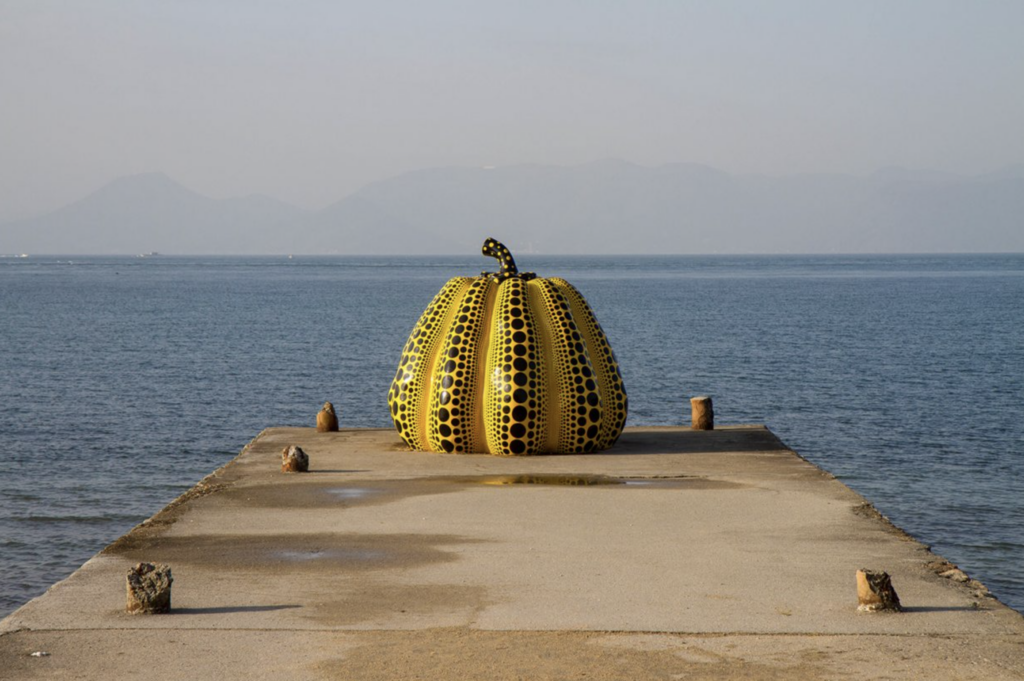
Being an “outsider” to the seriously regarded art world paradoxically helped her break deep into pop culture. Louis Vuitton hired her to help sell its luxury goods, filling its Fifth Avenue windows with an inflatable robot covered in her dots. She decorated Coca-Cola cans and Casio watches with her signature pattern.
It might look like selling out. Back in 1968, Kusama herself declared that “anything mass produced robs us of our freedom.” And yet, through her own sheer, mass-produced ubiquity, she may have become one of her own dots, spread into every corner of culture, high and low.
Legacy
Perhaps Gopnik put it best himself: maybe that inner, “insider” Kusama from the Green Gallery show survived after all, hidden deep within the “outsider” Kusama that a much wider public would later come to know.