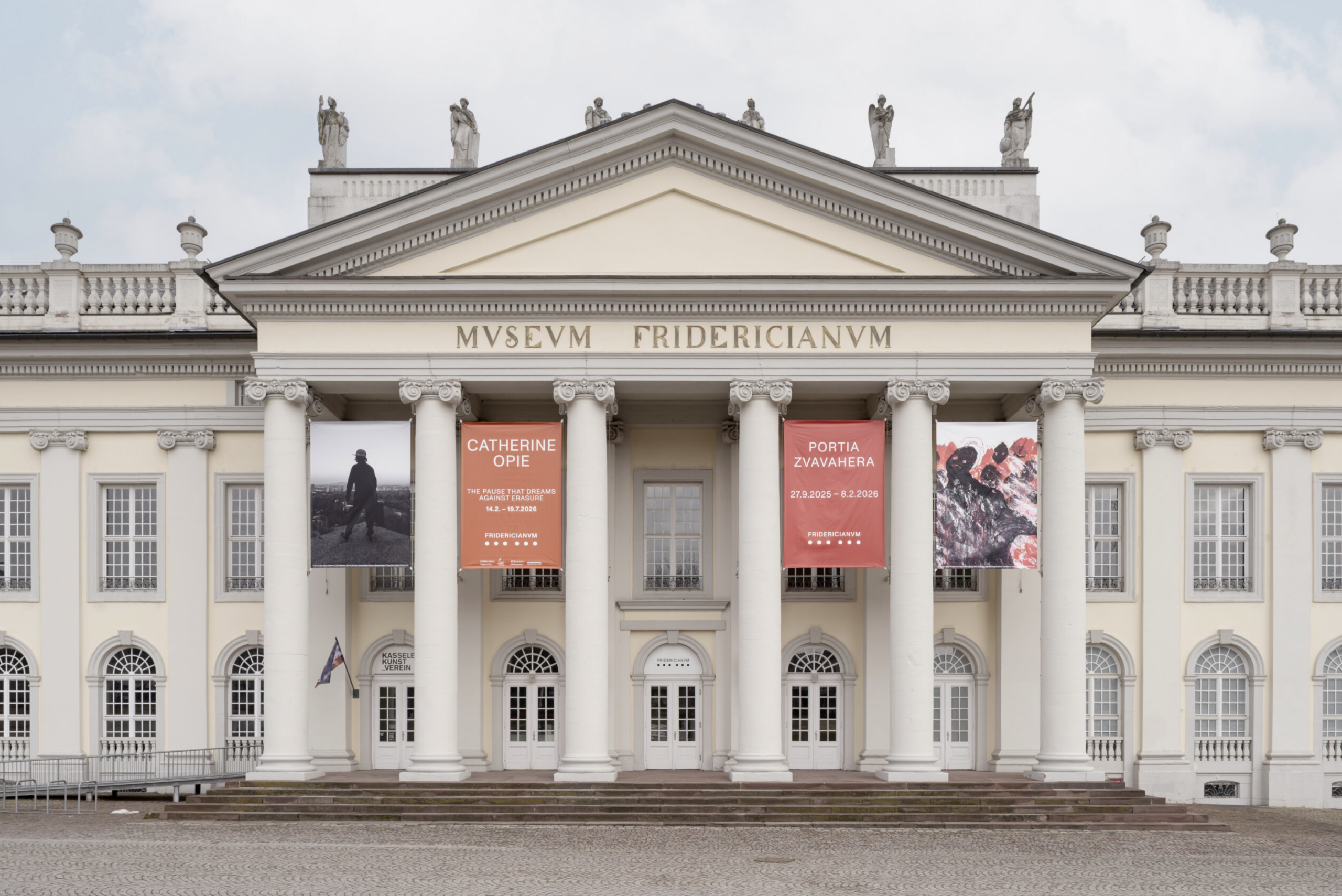
Kunsthalle Fridericianum in Kassel is hosting a major solo exhibition by Swiss artist Peter Fischli, his first in Germany. The show opened on May 23 and runs only until September 13, 2026. Fridericianum is part of documenta und Museum Fridericianum gGmbH, the same organization behind the world famous documenta exhibition.
The Circle Closes
Fischli is not returning to Kassel for the first time. Back in 1987, the artist duo Fischli/Weiss made their debut here at documenta 8. Managing director Andreas Hoffmann speaks of a symbolic closing of the circle. According to him, Fischli has returned as a solo artist to the exact place where the work of Fischli/Weiss first gained international attention in 1987. The exhibition thus builds a direct bridge to documenta’s history, while also proving that the Kassel art show remains a visionary source of inspiration.
Fridericianum director Moritz Wesseler has a personal connection to the exhibition too. As a six year old, he got lost from his parents at documenta in 1987. He was eventually found standing in front of the film Der Lauf der Dinge by Fischli/Weiss. In his own words, that moment sparked a lifelong fascination with art.
Traffic Lights Without Rules
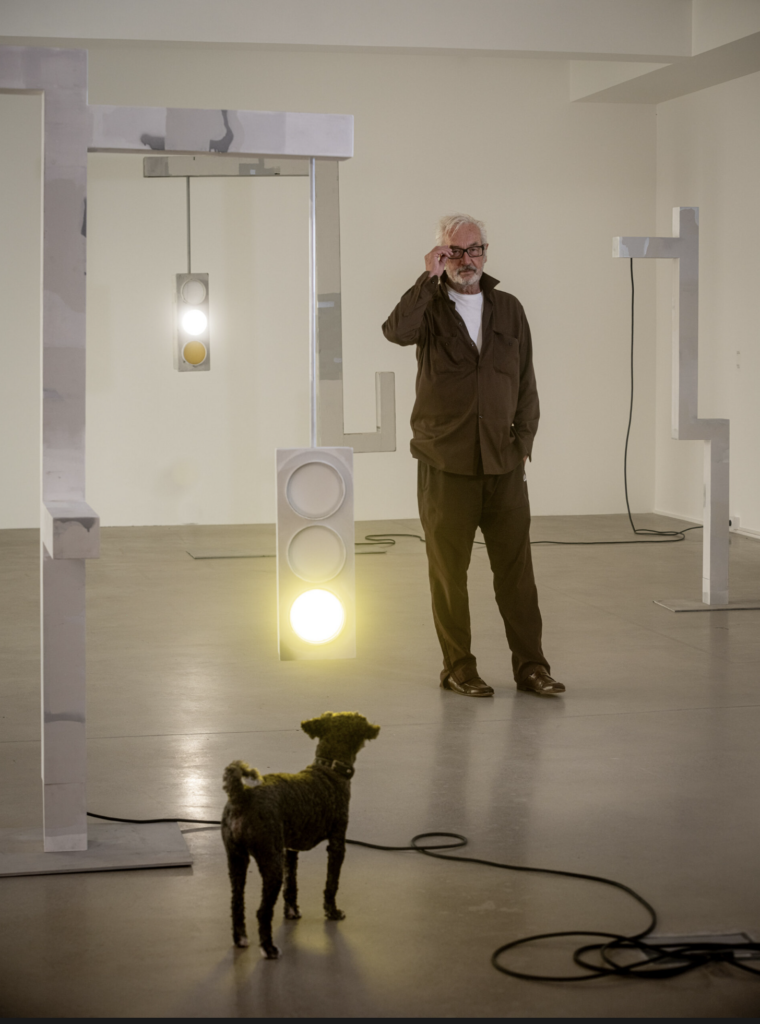
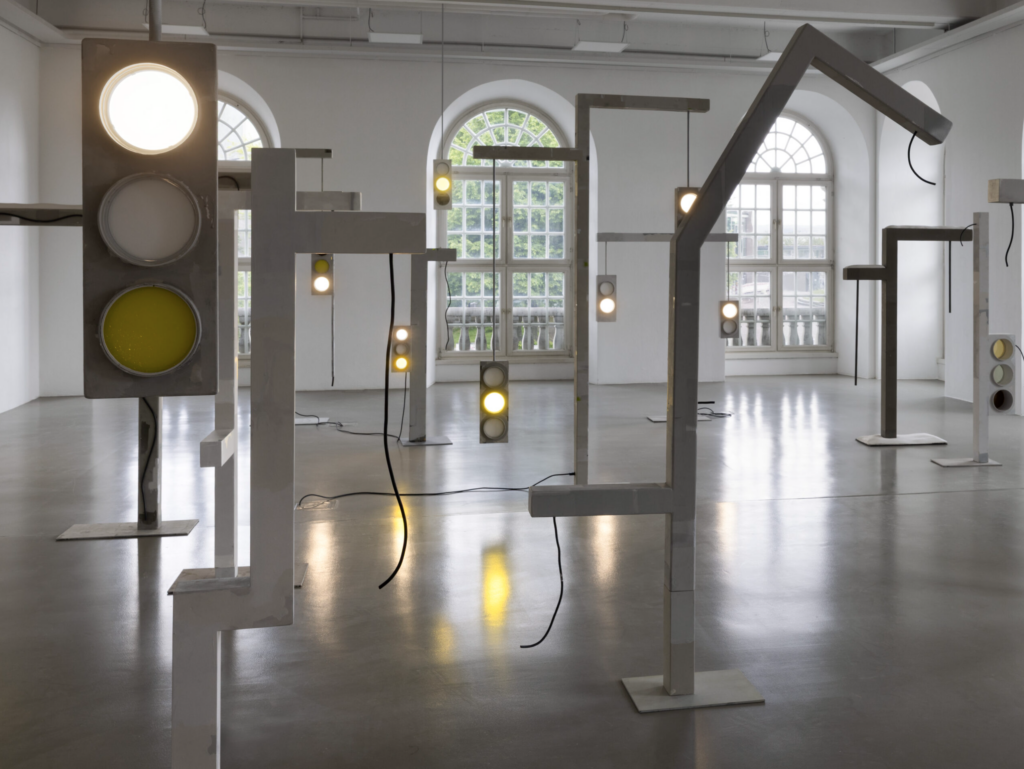
Kinetic sculptures form the heart of the exhibition. Visually, they recall street traffic lights or stage elements. Fischli built them from simple materials and coated them in gray paint. Vertical posts and horizontal arms carry luminaires that flash in white, orange, or yellow. Yet their rhythm follows no fixed logic. Instead, the sculptures generate their own unpredictable sequences.
Some pieces feature reflective panels or stained glass. Others have loose cables dangling from their frames. As a result, they also bring to mind gallows or bare trees. Visitors can read them as abstract compositions, diagrams, or even psychograms. This ambiguity is deliberate. Fischli’s practice examines the aesthetics of everyday life and the systems that organize how we move, perceive, and feel.
Tension, According to Bice Curiger
Curator and critic Bice Curiger moves through exactly that blurred zone between the recognizable and the inexplicable in her accompanying essay, Figure in Suspense. She points to Magritte’s iconic pipe, which, despite its perfect likeness, was never actually a pipe. Fischli plays a similar trick. His so called signals, as he prefers to call them instead of traffic lights, flash just as convincingly as the real thing, yet their sequence makes no sense whatsoever. Rather than guiding the way, they provoke the eye with a logic all their own. Curiger also draws attention to the geometric skeleton of the sculptures, built from the circle and the rectangle. She reads these as a binary code of dot and dash, an echo of Morse code and of the digital language the whole world now speaks.
From Collaboration to a Voice of His Own
Peter Fischli was born in Zurich in 1952, where he still lives and works today. Until 2012, he worked alongside David Weiss, who died that same year. Over four decades of collaboration, the duo Fischli/Weiss took part in documenta in both 1987 and 1997. They also represented Switzerland at the Venice Biennale, specifically in 1988, 1995, 2003, 2011, and 2013. In 2003, they won the Golden Lion for their installation Questions, a collection of more than a thousand existential questions gathered over the years.
For the past decade, Fischli has focused entirely on his solo practice. His work has since appeared at Kunsthaus Bregenz in 2020, at By Art Matters in Hangzhou, China, in 2024, at LUMA Arles in France in 2025, and, earlier this year, at Pinacoteca Agnelli in Turin and the Robert Walser Zentrum in Bern. The Kassel exhibition marks his first institutional solo presentation in Germany.
Beyond the Exhibition
Fridericianum also offers a rich accompanying program. Every Saturday, the free Studiowerkstatt is open to all. Public guided tours run every Wednesday and Sunday. On the last Thursday of each month, the museum stays open later as part of F wie Feierabend, with the café open until 10pm and the exhibition until 8pm.
Admission to Fridericianum costs 6 euros, with a reduced rate of 4 euros. Entry is free on Wednesdays. The exhibition is held under the patronage of Livia Leu, Switzerland’s ambassador to Germany, and is supported by the Swiss Arts Council Pro Helvetia. Anyone hoping to see Fischli’s signals in person now has less than a month left to do so.