
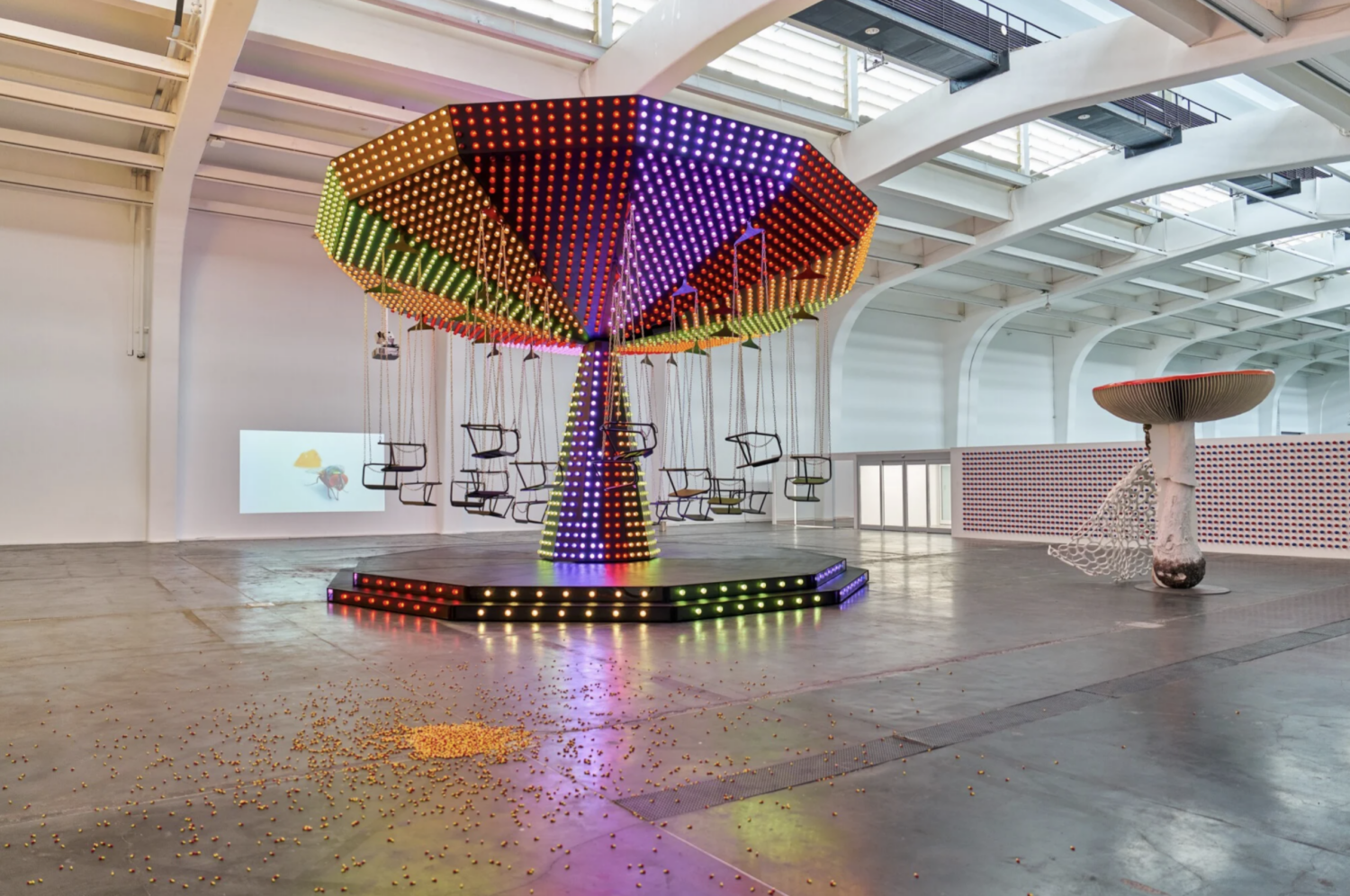
Carsten Höller invites visitors to question certainty in Two, an exhibition running at UCCA Center for Contemporary Art in Beijing through January 31, 2027. This marks his very first solo institutional exhibition in China. Here, the entire museum transforms into a dynamic environment, one where chance determines the outcome.
An Artist From the 1990s Generation
Höller emerged in the 1990s alongside artists like Maurizio Cattelan, Douglas Gordon, Pierre Huyghe, Philippe Parreno, Rirkrit Tiravanija, and Andrea Zittel. This generation became known for working with audience participation. They transformed the gallery into a space for experience, rather than simply a place to view art. This same principle defines his current exhibition in Beijing.
A Museum Split Into Two Worlds
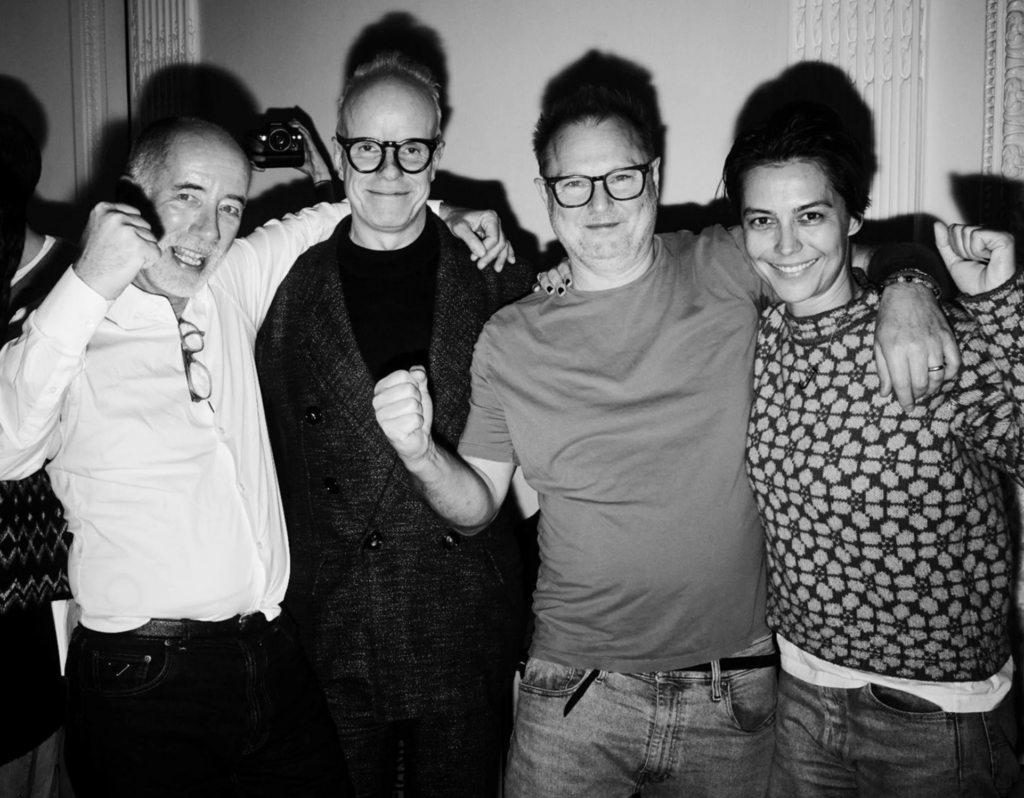
Philip Tinari and Jiashu Zou curated the exhibition inside UCCA’s grand hall, which Höller calls the Laboratory of Doubt. Upon arrival, visitors get randomly directed to one of two entrances. These lead into two parallel versions of the exhibition, one full of color, the other reduced to black and white. The installations largely overlap, yet no two paths through the museum turn out exactly the same. This suggests that reality itself shifts depending on circumstance and perspective.
Höller originally studied agricultural science. He didn’t turn to art until the early 1990s. Since then, he has approached exhibitions as experiments, drawing visitors into carefully constructed situations that explore perception, behavior, and the invisible forces shaping everyday life.
Slides for Miuccia Prada
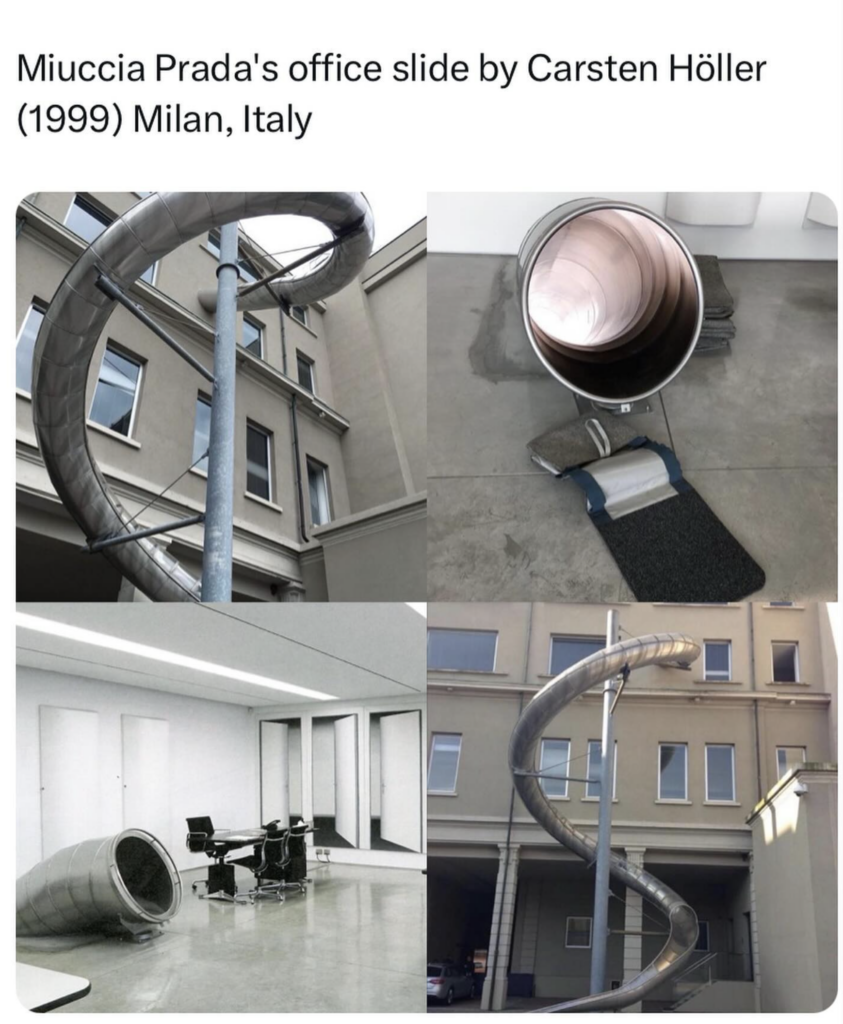
Höller remains well known for his long-running series of spiraling metal slides, a project he has worked on since 1998. He created one directly for Miuccia Prada’s office in Milan in 2000, while others appeared earlier at the Berlin Biennale in 1998. In Two, he applies this same principle in Beijing: turning an ordinary amusement device into an art object.

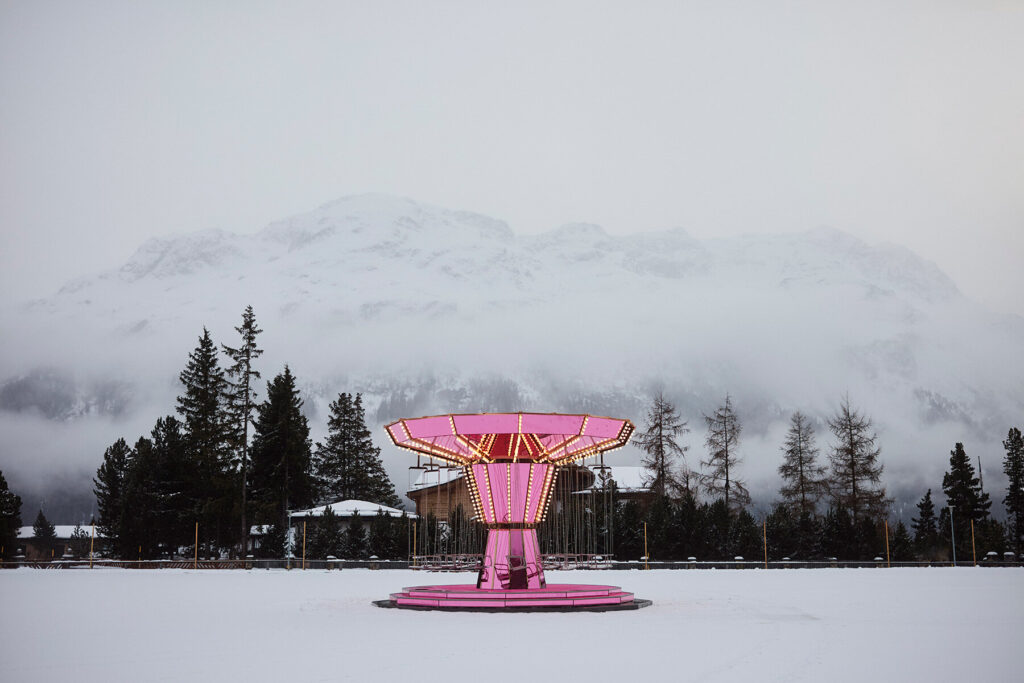
Höller’s carousels rank among his most recognizable works, a series he has developed since 1998. Crucially, he always alters something we normally expect from a funfair ride, most often speed, sometimes direction, sometimes surface material. In his 2006 exhibition Amusement Park at MASS MoCA, both the slowdown rate and direction changed daily. He repeats this exact principle in Beijing now, where Tilted Carousel (Five Colours) and Tilted Carousel (Two Whites) slow the carousel down so much that observation and patience replace the thrill of the ride.
Works That Test Perception
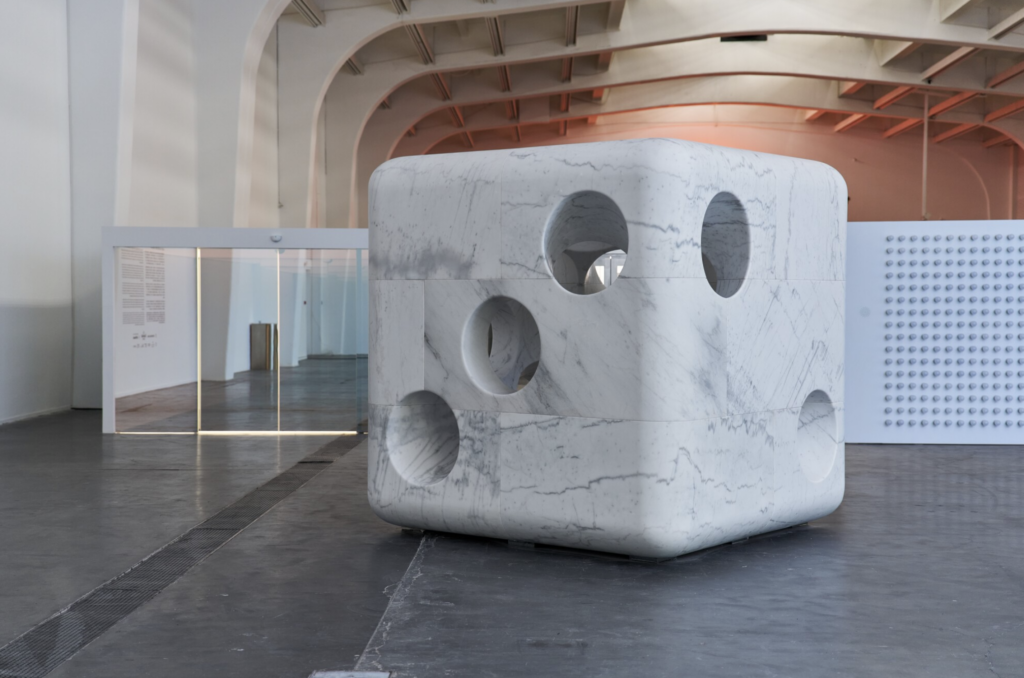
Dice (Chinese Marble) enlarges a single die into a monumental marble structure, one visitors can actually walk into. Pill Clock, meanwhile, dispenses a tablet containing an unspecified substance every three seconds, matching the exact interval Höller associates with the present moment. Both works explore chance, control, and our perception of time.
Science, Memory, and Nature
The Divisions series repeatedly splits painted surfaces according to simple rules, generating increasingly fine compositions that move toward infinity. Smell of My Mother and Smell of My Father, meanwhile, reconstruct the scents of Höller’s own parents, turning memory and heredity into an invisible sensory experience that explores identity, resemblance, and attraction.
The 2024 work Giant Triple Mushroom combines enlarged cross-sections of three mushroom species into one monumental hybrid form. It grows out of Höller’s long-standing interest in biology and celebrates the complexity of fungi. At the same time, it serves as a reminder: science can illuminate nature, but it can never fully explain its mysteries.

