
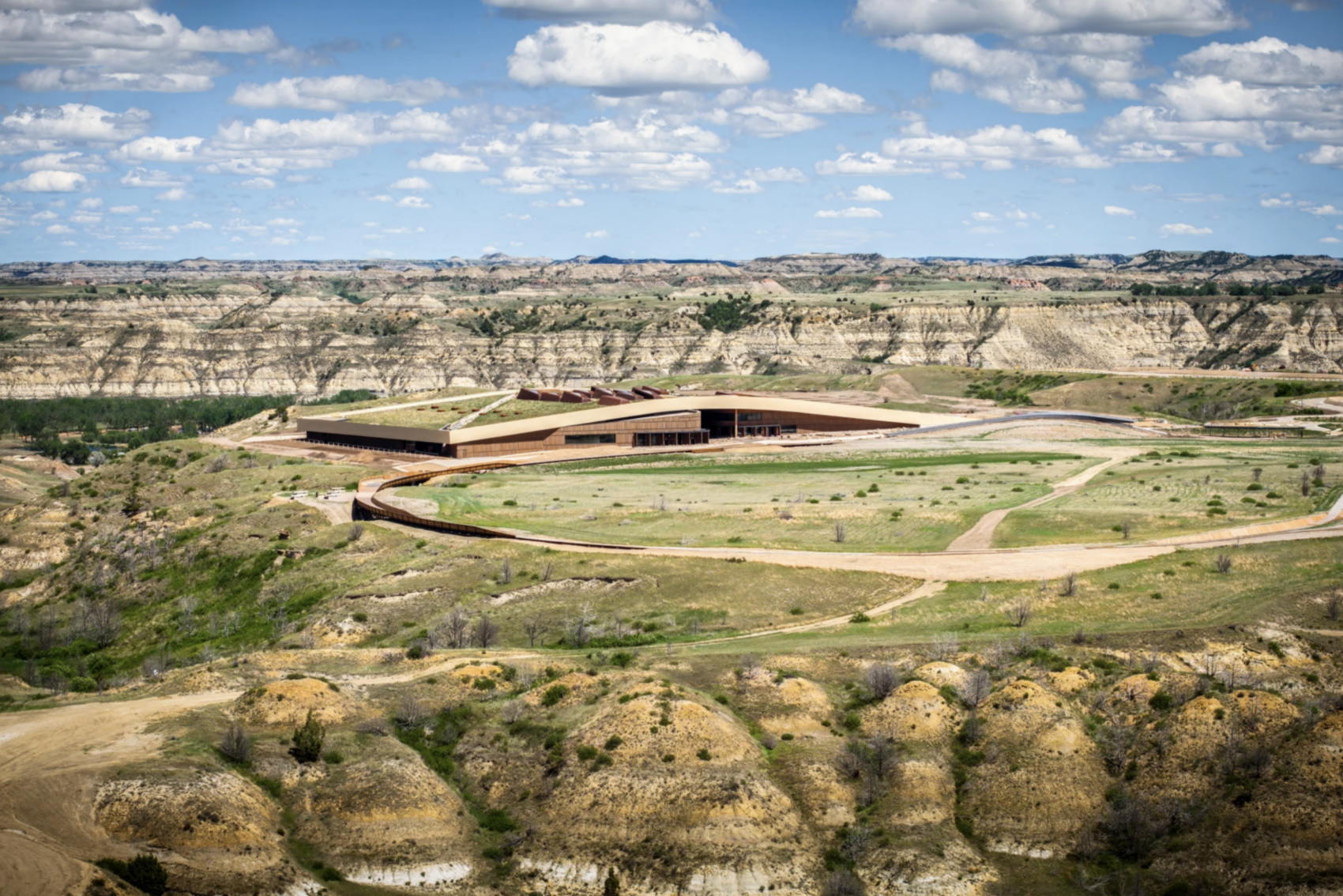
A new Theodore Roosevelt Presidential Library now stands in North Dakota. It sits within the Badlands, a dry, wind-eroded landscape full of ravines and colorful rock layers. Snøhetta designed the building. The $450 million structure spans roughly 8,600 square meters. Rather than dominating the landscape, it sits carefully set into the hillside. From most angles, it nearly blends into the surrounding hills.
Who Was Theodore Roosevelt
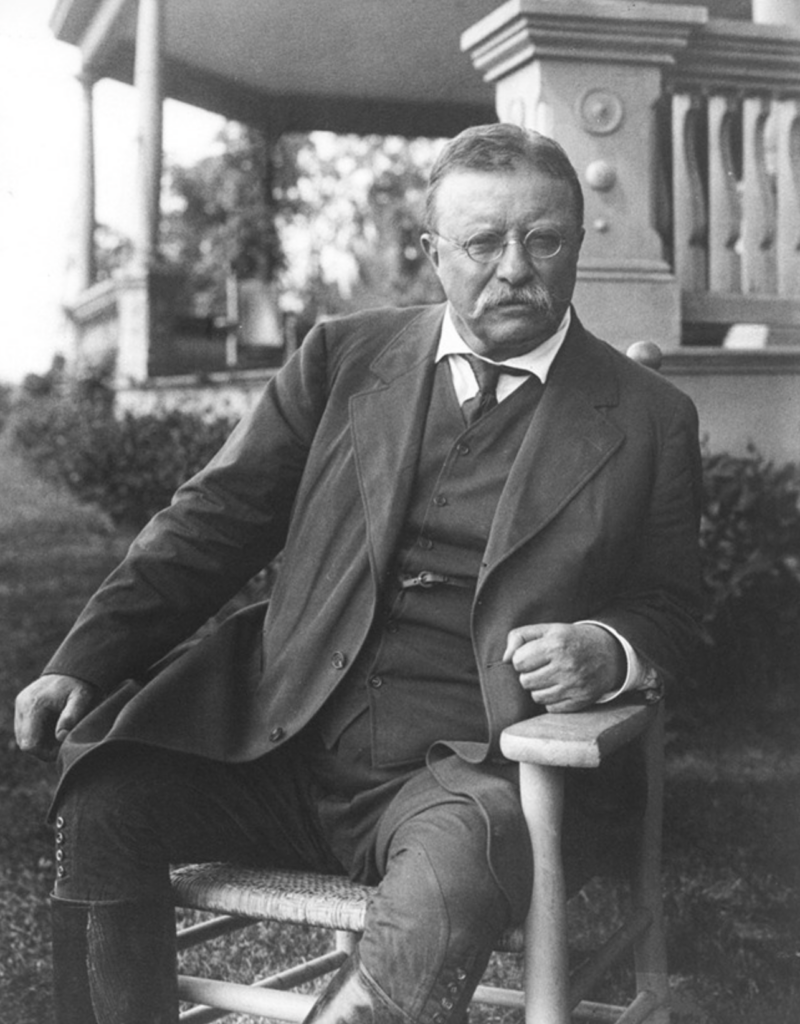
Theodore Roosevelt served as the twenty-sixth president of the United States, in office from 1901 to 1909. Before that, he led the volunteer cavalry regiment known as the Rough Riders during the Spanish-American War. He also served as governor of New York. As president, he remains best known for protecting millions of acres of American wilderness and establishing several national parks and forests. He died in 1919.

Pozor, dvaja Rooseveltovci
Watch Out, There Are Two Roosevelts
Theodore Roosevelt, the president honored by this library, isn’t the same person as Franklin Delano Roosevelt, the American president during World War II. They were two distant relatives. Theodore served as the twenty-sixth president from 1901 to 1909, while Franklin Delano became the thirty-second president from 1933 to 1945. Photographs and materials of both men often get mixed up online, so it’s worth double-checking which Roosevelt you’re actually looking at.
Why Medora
Roosevelt first came here in 1884, following the deaths of his wife and mother, who died on the very same day. He spent the following years ranching and hunting, far from New York politics. This exact experience later shaped his lifelong belief that wilderness deserved protection.

A Roof You Can Walk On
The building splits into two pavilions, one housing the museum and restaurant, the other holding an auditorium and classrooms. A walkable roof connects them, spacious enough to fit an entire soccer field. This walkable roof has long served as a Snøhetta signature; the studio used the same principle at the Oslo opera house. Native prairie grasses cover both the roof and the surrounding grounds.
Building With Earth as Sculpture
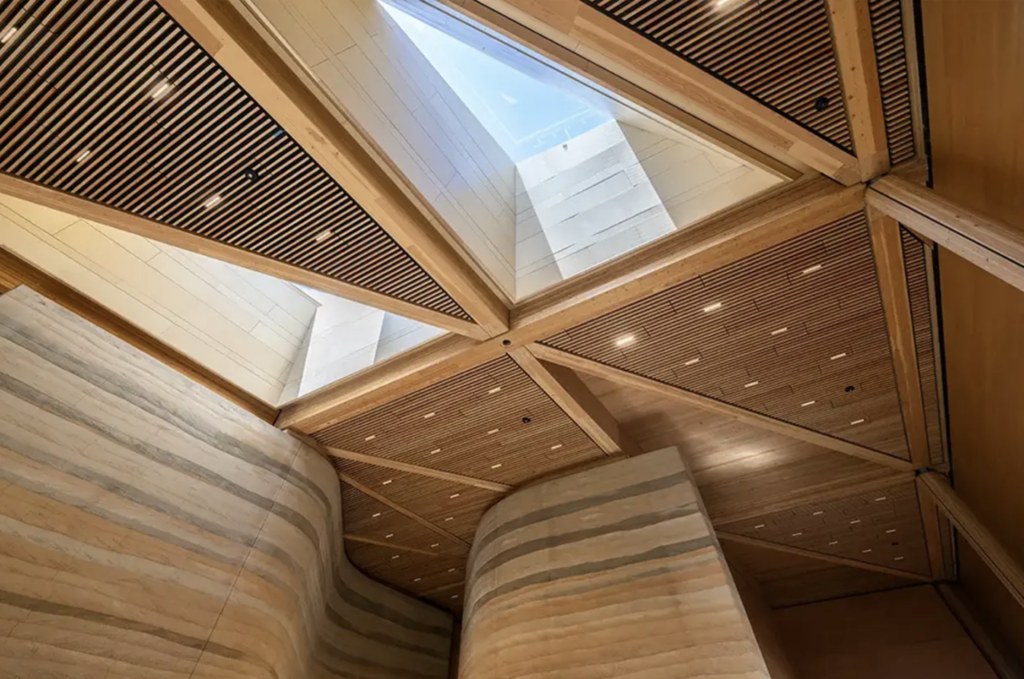
The interior walls are made from rammed earth, a technique once used by both Indigenous peoples and European settlers. The rippling, colorful layers read almost like abstract sculptures, echoing the geological layers found throughout the surrounding landscape.
A Sculpture That Stayed in Storage
The original exhibition plan included an equestrian statue of Roosevelt by sculptor James Earle Fraser, which stood for decades outside New York’s American Museum of Natural History. The statue depicts Roosevelt on horseback, with an African man and a Native American man standing beneath him, a composition critics have long called racist. New York removed the statue from public space in 2022, and it ultimately never made it into the library as an exhibit either. Today, it remains in storage.
Art Replaced by Algorithm
Instead of a statue, visitors entering the exhibition are greeted by an AI hologram of Roosevelt, created by Microsoft, which answers their questions directly. While the previous generation addressed presidential memory through sculpture, today’s library reaches for artificial intelligence instead.

Snøhetta Also Built SFMOMA
Snøhetta ranks among today’s most distinctive architecture studios. Beyond the Oslo opera house, the firm also designed the 2016 expansion of the San Francisco Museum of Modern Art, adding a rippling white facade that expanded SFMOMA’s original building with new exhibition floors. The same interest in landscape and natural materials visible in North Dakota runs through most of the studio’s work.
