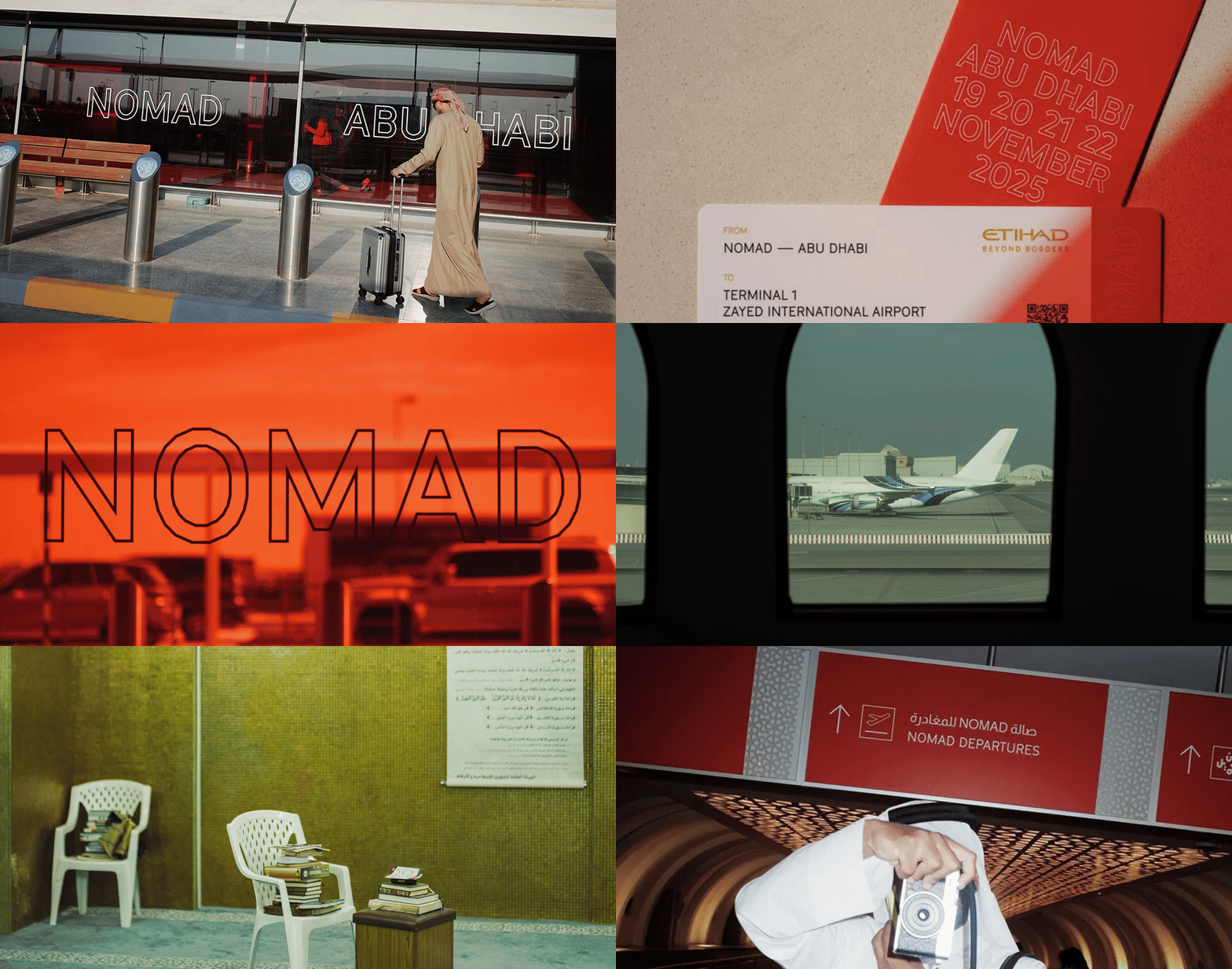
What do an airport from 1982, bronze furniture from Ouagadougou and Bahraini pearls have in common? NOMAD Abu Dhabi. From 18 to 22 November, the travelling fair for collectible design returns to Terminal 1 of the old Abu Dhabi airport. Its second edition brings together more than 50 exhibitors, and its common thread is craft that travels between cultures.
A fair that travels
NOMAD was founded in 2017 by Nicolas Bellavance-Lecompte and Giorgio Pace. The first edition took place in Monaco, at Villa La Vigie, Karl Lagerfeld’s former residence. Since then the fair has been on the move: St. Moritz, Venice, Capri, Cannes and, this summer, the Hamptons for the first time.
Today it is run by Bellavance-Lecompte alone, a Canadian-Italian architect and curator. In Beirut he co-founded Carwan Gallery, one of the first contemporary design galleries in the Middle East. The NOMAD principle is always the same: instead of an exhibition centre, an extraordinary piece of architecture that becomes part of the show.

Terminal 1
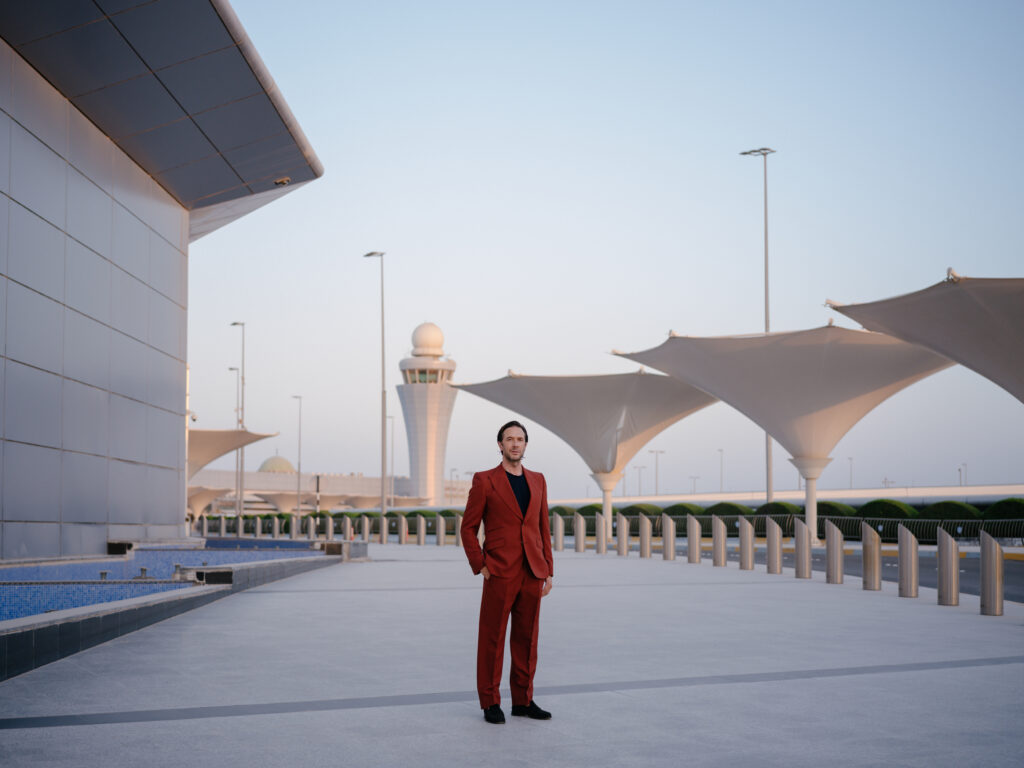
Terminal 1 was designed by French architect Paul Andreu, the architect of Charles de Gaulle Airport in Paris. It opened in 1982 at the initiative of Sheikh Zayed bin Sultan Al Nahyan. At its heart is a circular waiting hall with a mosaic vault resembling a palm tree. In November 2023 the new Terminal A took over operations and the old building closed. In 2026 Abu Dhabi added it to its Modern Heritage Register.

Andreu did not design airports alone. In Paris he worked with Danish architect Johann Otto von Spreckelsen on the Grande Arche at La Défense. In Beijing he designed the National Centre for the Performing Arts, whose titanium and glass dome opened in 2007 near Tiananmen Square. Airports have fascinated artists too. From the late 1980s, the Swiss duo Peter Fischli and David Weiss photographed them on their travels around the world. In 1990 they published the book Airports, and in 2012 the complete 800 Views of Airports: hundreds of photographs without a single caption.

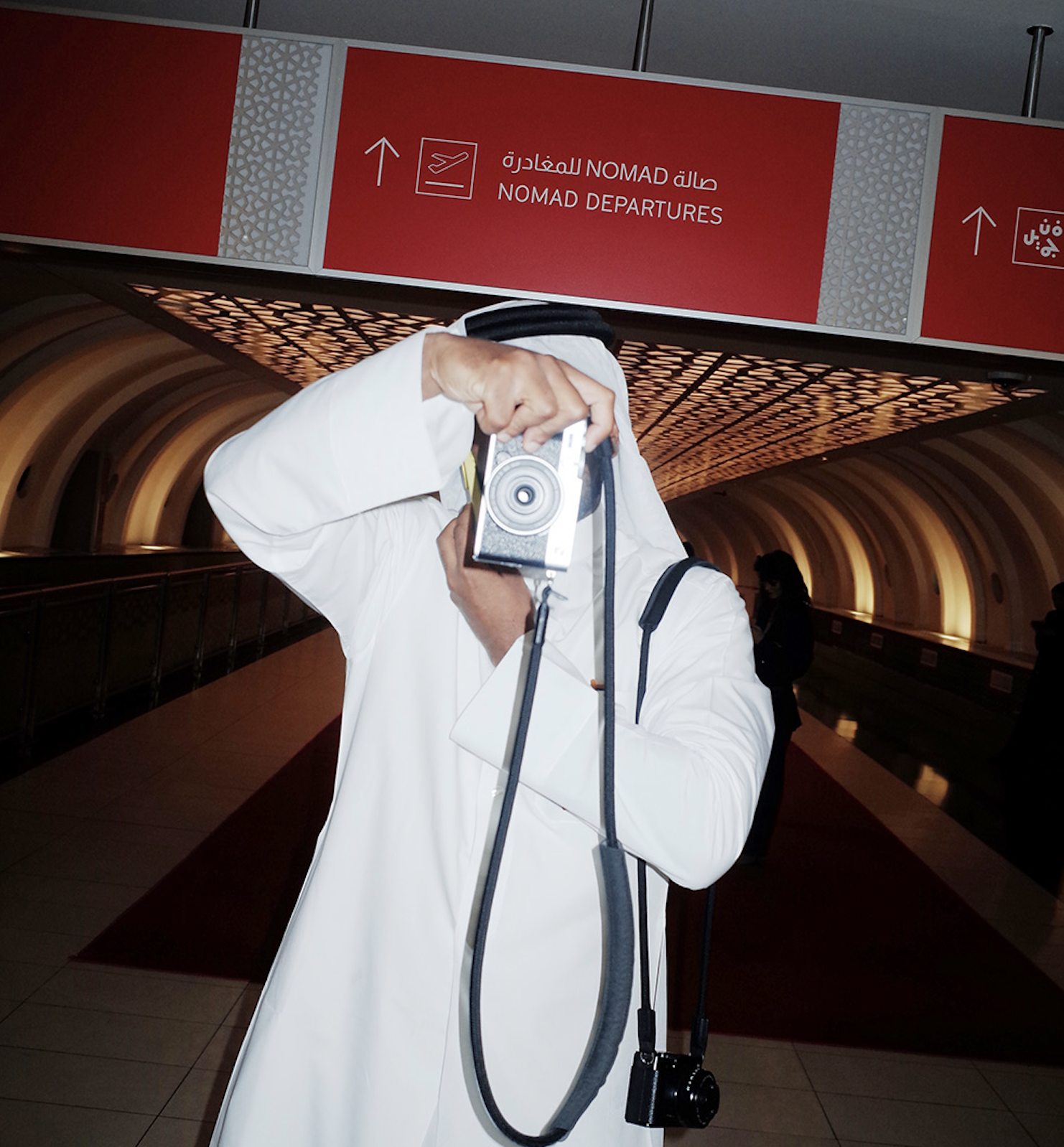
Last year NOMAD was discovering the building: visitors received a boarding pass and went through check-in before entering the hall. This year it goes further. Four private gates become standalone presentations by A2Z, Nilufar, Gallery FUMI and Galerie Gastou. Further projects unfold through the former departure areas and corridors.
Craft that travels
The airport was a place where people from all over the world met. Now it is techniques that meet here: bronze, silver, lacquer, textile and mother-of-pearl.
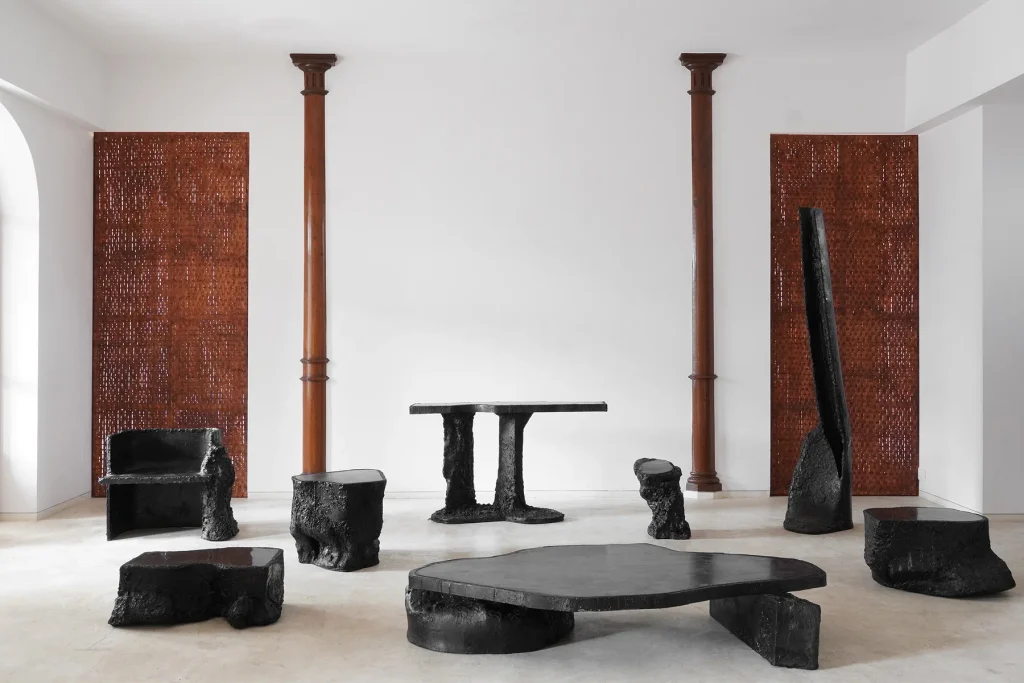
Mumbai gallery ÆQUŌ joins NOMAD for the first time, bringing sculptural furniture by French designer Frédéric Imbert. Imbert spent two weeks in the Indian state of Chhattisgarh with master craftsman Suresh Waghmare, sculpting directly in black wax for the Dhokra technique, a tradition more than 4,000 years old. He deliberately left the welding marks on the brass pieces as a signature.
The same lost-wax technique is used by Maison Intègre, founded in 2017 by Ambre Jarno in Ouagadougou, Burkina Faso. To Abu Dhabi it brings bronze furniture as well as two monumental tapestries from the Tree of Life series, coloured with natural dyes.
Similarly, Seoul’s Gallery Vein brings several generations of Korean makers together with the traditions of bandaji furniture, ottchil lacquer and mother-of-pearl. Among them is master craftsman Kangyong Park.
Finally, Bahrain’s MATTAR draws on more than 180 years of family knowledge of natural pearls. In Woven in Us, developed with Bahraini weavers and designers, the pearl becomes material and memory, not just adornment.
he Emirates in the Departure Hall
In the Departure Hall, the focus turns to the Emirates. Irthi Contemporary Crafts Council, which creates new opportunities for women artisans, presents the Al Taif – Al Thini Edition collection with studio SUPER LOOP. Its five pieces of furniture draw on Emirati Talli weaving and are complemented by pearl inlay.
The first commission of the new Design Commission Abu Dhabi is an installation by French-Sudanese designer Abdel El Tayeb. House of Artisans and the Paris-based Institut du Monde Arabe paired him with Emirati master artisans. The Institute’s building was designed by Jean Nouvel and opened in 1987. Its south façade is made of light-sensitive diaphragms that open and close with the light, a reference to the Arab mashrabiya.

Abdel El Tayeb: from fashion to craft
El Tayeb is a French-Sudanese designer from Bordeaux. He studied textile design at Olivier de Serres in Paris and fashion at La Cambre in Brussels. He worked for Isabel Marant and Maison Margiela Artisanal, then spent several years as a womenswear designer at Bottega Veneta in Milan. In 2021 Naomi Campbell presented him with the Debut Talent award at Fashion Trust Arabia in Doha, and in 2025 he was named Emerging Talent of the Year at the Belgian Fashion Awards.

His label El Tayeb Nation draws on Sudan’s history and present. Palm-leaf basketry, which he learned from a relative in Sudan, finds its way into his embroidery and cuts. To Abu Dhabi he brings a practice in which craft comes first.
Architecture as a signature
In Light into Colour, Boghossian and Ars Belga place high jewellery alongside postwar painting by Piero Dorazio, Charles Pollock, Salvo and Lorenzato, looking for what gemstone and pigment have in common.
The ELITE Lounge by Chalhoub Group brings together Max Mara, Repossi and De Beers under the concept The Art of Living.

For Repossi, architecture is part of the handwriting. In 2016 Gaia Repossi entrusted the redesign of the historic boutique at 6 Place Vendôme to Rem Koolhaas and his studio OMA. Within 90 square metres they created three spaces, a kinetic display wall and a staircase made of aluminium foam.

Beyond the terminal
This year the NOMAD Hub is at ERTH Abu Dhabi, the former Armed Forces Officers’ Club. The building was designed by Roger Taillibert, architect of the Olympic Stadium in Montreal. Erth means heritage in Arabic.
At Terminal 1, South African artist Robin Rhode will create a wall drawing and performance that develops over the course of the fair, in collaboration with Public Art Abu Dhabi.
Practical information
NOMAD Abu Dhabi, Terminal 1, Old Abu Dhabi Airport. 18 November: preview by invitation only. Open to the public 19–21 November from 1 pm to 9 pm, and 22 November from 1 pm to 8 pm.
In the same week, from 19 to 22 November, the first Frieze Abu Dhabi takes place at Manarat Al Saadiyat.